


Reviewed by Jones‑Hope Legal for general accuracy only. This information is not legal advice. Individual circumstances vary and readers should obtain personalised advice.
For many Australian veterans and their families, engaging with the Department of Veterans’ Affairs (DVA) has never been a neutral administrative task. It has often required revisiting injury, illness, trauma, and loss while navigating a system shaped by multiple pieces of legislation written at different points in history. Each Act was created with the intention of supporting veterans; yet, over time, the combined effect has been a system that many have experienced as confusing, inconsistent, and emotionally exhausting.
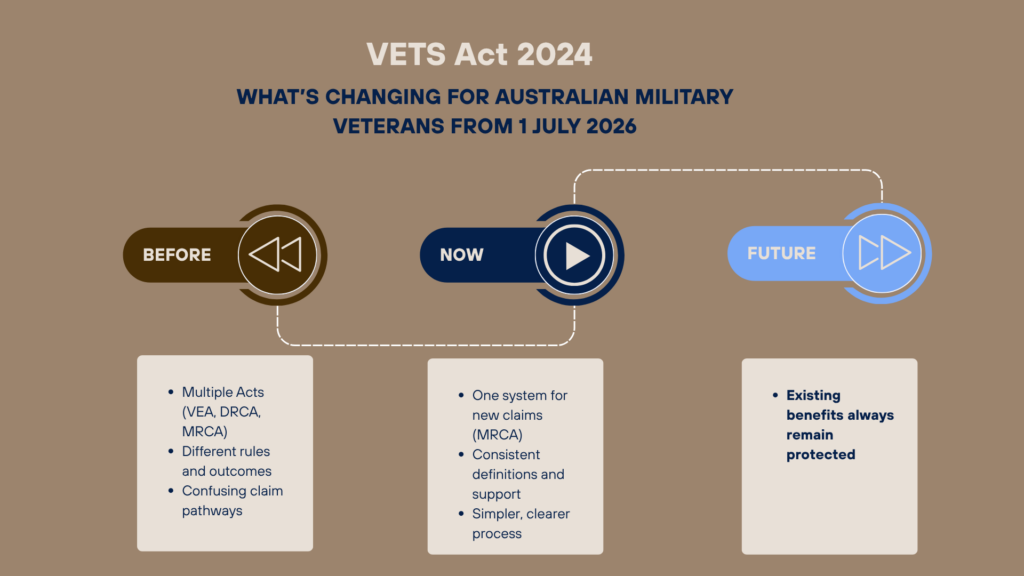
For decades, veterans’ compensation, treatment, and rehabilitation have been governed by the Veterans’ Entitlements Act 1986 (VEA), the Defence-related Claims Act 1988 (DRCA), and the Military Rehabilitation and Compensation Act 2004 (MRCA). Which Act applies depends largely on when and how a person served, rather than on the severity of their injury or the impact on their life. DVA has acknowledged that this fragmentation has made the system difficult for veterans and families to understand and challenging for staff and advocates to administer consistently.
This complexity has not been merely inconvenient. The exposure draft accompanying the VETS Act explicitly recognises that navigating multiple legislative frameworks can, itself, be a source of stress and harm, particularly for veterans already managing physical injury, chronic illness, or mental health conditions (DVA, 2024b). Over time, this understanding has reshaped how reform is framed, not just as legal simplification, but as a wellbeing measure.
The system we have today
Under the current framework, veterans may receive very different forms of support depending on which Act applies to them. For example, the VEA primarily supports veterans with qualifying war-like or operational service, particularly those who served before 2004, while DRCA covers defence-related injuries and illnesses, often linked to peacetime service, and MRCA applies to service-related conditions arising from 1 July 2004 onwards.
Each Act has its own definitions, eligibility thresholds, benefit structures, and review pathways. As a result, two veterans with similar injuries can receive different levels of compensation, rehabilitation access, or household support purely because of the legislative scheme that applies to their service. DVA has openly acknowledged that these inconsistencies are difficult to justify and challenging to explain to veterans and families seeking clarity and fairness.
For veterans with long or complex service histories, this can mean managing entitlements across more than one Act at the same time. In practical terms, this may involve different payment types, medical arrangements, and administrative requirements running concurrently, a burden that often falls not only on veterans, but also on their families and carers.
What the VETS Act does
The Veterans’ Entitlements, Treatment and Support (Simplification and Harmonisation) Act 2024 (VETS Act) represents a fundamental shift in how Australia approaches veterans’ support. Rather than layering another piece of legislation onto an already complex system, the reform consolidates future compensation and rehabilitation under a single, modernised MRCA framework.
From 1 July 2026, new claims for compensation, rehabilitation, and related supports will no longer be accepted under the VEA or DRCA. Instead, all new claims (regardless of when the service occurred) will be assessed under the modernised MRCA. This removes the long-standing requirement for veterans to first determine which Act applies before they can even begin a claim.
In practical terms, this means a veteran who served prior to 2004, but develops a service-related condition decades later, will no longer need to navigate multiple legislative pathways. Instead, they will enter a single, consistent claims process with common definitions, standards of proof, and decision-making structures. DVA has identified this as one of the most significant barriers to access that the VETS Act seeks to remove.
What happens to current veterans and families
A central and non-negotiable principle of the VETS Act is the protection of existing entitlements. Veterans currently receiving payments, treatment, or services under the VEA or DRCA will continue to receive those supports under the same legislative arrangements. There is no automatic transfer to the new system, no reassessment of existing conditions, and no reduction in benefits.
This principle of ‘grandparenting’ is clearly articulated in both public explanations of the reform and in the exposure draft legislation itself. It reflects an understanding that veterans and families have built financial security, healthcare access, and life plans around their existing entitlements, and that reform must not destabilise those arrangements.
For families, this assurance provides critical certainty. It means that the support relied upon today will remain in place, even as the broader system evolves.
Your choices under the new framework
While existing arrangements remain protected, the VETS Act introduces meaningful flexibility for veterans currently covered by the VEA or DRCA. If, after the commencement of the Act, a veteran experiences a deterioration of an accepted condition or develops a new service-related injury or illness, they may choose to lodge that new claim under the modernised MRCA framework.
This choice can result in tangible benefits. For example, a veteran with an older accepted condition under the VEA, and who later develops secondary mobility or functional issues, may find that MRCA’s rehabilitation and impairment provisions offer broader or more responsive support. Importantly, this does not require relinquishing existing benefits; the original entitlements remain under the original Act, while new claims are assessed under MRCA.
The exposure draft explains that this approach is intended to better reflect the reality that health conditions evolve over time and that veterans’ support needs can change long after service has ended.
What this means for serving members and future veterans
For current serving members and those who will serve in the future, the impact of the VETS Act is more straightforward. From July 2026, there will be one compensation and rehabilitation framework governing service-related injury and illness. This clarity removes uncertainty during transition from Defence to civilian life, particularly for members injured late in their careers or following multiple postings.
The Department has emphasised that a single system supports earlier engagement with rehabilitation, clearer education about entitlements, and more consistent decision-making throughout the life of a claim. This also lets Defence provide clearer guidance to serving members about how injuries sustained during service will be supported long after discharge.

Positive changes in practice
The modernised MRCA framework has been strengthened to address known gaps and inconsistencies across the existing system. Rehabilitation provisions are expanded to support long-term recovery and participation, including for older veterans and dependants. This reflects a shift away from viewing rehabilitation solely as a return-to-work mechanism and toward recognising its role in independence, wellbeing, and quality of life.
Compensation arrangements have also been refined to better reflect functional impact. The introduction and enhancement of additional disablement amounts for veterans with severe impairment acknowledge that some injuries fundamentally alter daily life, not just earning capacity. This change responds to long-standing concerns that previous arrangements did not adequately capture the lived experience of severe injury or illness.
Another practical improvement is the harmonisation of allowances such as travel for treatment. Under the previous system, reimbursement rules differed between Acts, sometimes leaving veterans out of pocket simply because of legislative classification. Standardising these provisions reduces administrative burden and supports more equitable access to care.
What this means for families
Families and carers are often deeply involved in navigating the veterans’ support system. They attend appointments, manage paperwork, and provide daily support, often while balancing work, caregiving, and their own wellbeing. Legislative complexity can amplify stress at times when families are already under significant pressure. By simplifying pathways and harmonising rules, the VETS Act aims to reduce this burden. Clearer systems make it easier for families to understand entitlements, advocate effectively, and plan for the future. Over time, this reform is intended to let families spend less energy deciphering bureaucracy and more energy supporting recovery, connection, and everyday life.
Looking ahead
The VETS Act does not promise instant change. Implementation will take time, and education and communication will be essential as the July 2026 commencement approaches. The Department has acknowledged the importance of working closely with veterans, families, advocates, and service organisations to ensure the transition is well understood and carefully managed.
What the reform does represent is a clear change in direction away from a fragmented system built around service eras and toward a framework designed around people and their needs across time.
For veterans and families, the message is steady and reassuring: existing support is protected, new options will be available as circumstances change, and future generations of veterans will encounter a system that is simpler, clearer, and more consistent than the one that came before.
In that sense, the VETS Act is not just legislative reform. It is an acknowledgement that how support is delivered matters, and that clarity, fairness, and dignity are essential to honouring service.
References
Department of Veterans’ Affairs. (2024a). The VETS Act: What it is and what it will do. Australian Government.
https://www.dva.gov.au/about-us/inquiries-and-reviews/veterans-legislation-reform/the-vets-act-what-it-is-and-what-it-will-do
Department of Veterans’ Affairs. (2024b). Veterans’ Entitlements, Treatment and Support (Simplification and Harmonisation) Bill 2024 – Exposure Draft. Australian Government.
https://www.dva.gov.au/sites/default/files/2024-02/Veterans%27%20Entitlements%2C%20Treatment%20and%20Support%20%28Simplification%20and%20Harmonisation%29%20Bill%202024%20-%20Exposure%20draft.pdf