Australia’s disaster response system depends on a volunteer workforce that is under increasing strain, as participation declines among younger Australians while operational demands continue to grow. Sustaining this capability depends on retention, structure, and clear pathways that connect service to longer-term outcomes, rather than relying on recruitment alone.
Australia prides itself on showing up when disasters strike. Floods, bushfires, and cyclones have repeatedly drawn thousands of volunteers into communities battered by natural disasters. However, behind the familiar images of high-vis heroes and mud armies lies a growing problem. Australia’s disaster response relies heavily on long-term service from volunteers, but volunteer emergency responders are ageing, and there are not enough young Australians stepping in to replace them.
Running alongside this demographic shift is a less visible but equally constraining force: time poverty. As Tina Innes from Buddy Up Australia explains, many volunteers are not stepping away from service, but from the practical realities of sustaining it.
“The current economic environment means that people have less time. They need to get second jobs to maintain their own lifestyle, and so they have less time to volunteer,” she says.
Even within a highly purpose-driven community of veterans and first responders, where commitment to service runs deep, she notes a steady drop-off in participation over time as personal and financial pressures take hold.
This compounds the strain on an already ageing volunteer base, while shaping the expectations of younger Australians, who are entering adulthood with less time, less stability, and fewer opportunities to commit long term.
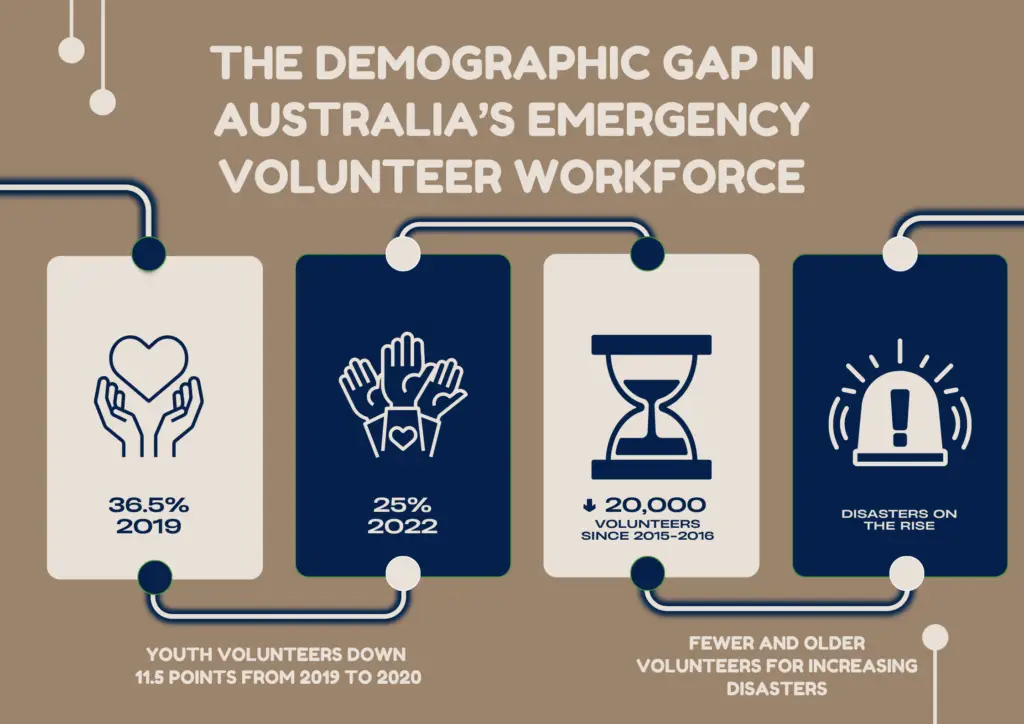
The proportion of Australians aged 18-to-24 who volunteered fell from 36.5 per cent in 2019 to just 25 per cent in 2022. While older Australians continue to form the backbone of services like the State Emergency Service (SES), Rural Fire Service (RFS), and Surf Life Saving (SLS), more than 20,000 volunteers have disappeared from state-run emergency services nationwide since 2015–16. The system is under growing strain, and the consequences are becoming harder to ignore.
At the same time, disasters are becoming more frequent, more severe, and more complex. That concern has been formally recognised at the national level. Two Senate inquiries in recent years have warned that Australia’s volunteer emergency workforce is in structural decline. Both inquiries called for stronger national frameworks to attract and retain younger Australians into emergency response roles.
Introducing the Disaster Resilience report, Senator Jacquie Lambie said, “We must find a way to incentivise young Australians to participate in volunteer organisations that provide support for disaster response and recovery.”
Addressing the volunteering problem with structured assistance
At first glance, the challenge appears to be one of recruitment, as fewer young Australians are signing up. But recruitment and retention are not the same problem, and conflating the two obscures where the pressure really lies.
While attracting young people into emergency services is difficult, keeping those who already volunteer is the bigger challenge. Emergency agencies invest heavily in training new recruits, often over many months, yet a significant proportion of young volunteers disengage before that investment translates into operational readiness. Therefore, solving the volunteer crisis requires more than increasing sign-up numbers. It requires giving young people reasons and pathways to stay.
Peter Kaye AM, LVO, ESM, former CEO of Duke of Edinburgh’s International Award in Australia, has seen this pattern play out over decades. A former SES volunteer and commander with 50 years of experience, Kaye says younger Australians often engage episodically, turning up for clean-ups or recovery days, but rarely remaining long enough to justify the intensive training required for frontline disaster response.
According to Kaye, volunteer emergency response agencies face an annual shortfall of around 30,000 volunteers under the age of 30 simply to replace older volunteers who are retiring or ageing out of frontline roles. Without that level of youth participation each year, overall response capacity continues to decline.
“The issue isn’t motivation,” Kaye says. “Young people want to help. The problem is retention. Agencies invest heavily in training, yet many young volunteers leave after a short period because there is no recognised pathway that connects service to future opportunity. Without structure, incentives, or accreditation, early enthusiasm fades before it turns into long-term capability.”
The challenge is compounded by the changing nature of disaster response itself. Modern emergency operations demand far more than goodwill and physical labour. Volunteers now need technical skills, situational awareness and the ability to operate safely in hazardous environments under clear command structures.
At the same time, many young Australians arrive with less practical experience than previous generations. High-density living, long study hours, casualised work, and family pressures mean fewer opportunities to learn basic skills such as handling tools or navigating building spaces. As a result, agencies must train volunteers with greater intensity and depth, increasing both the time and cost involved.
Safety is an unavoidable concern. Disaster response is high-risk work, and spontaneous volunteering can expose people to polluted floodwater, chemicals, unstable structures, and serious injury if it is not properly managed.
“This type of volunteering has to be structured,” Kaye says. “Young people can absolutely contribute, but only under clear training frameworks, safety arrangements, and command structures.”
Where that structure exists, retention improves markedly. Duke of Edinburgh does not run emergency services, though it provides a nationally recognised framework that allows volunteering and training with organisations like the SES, Red Cross, and Surf Life Saving to count toward formal accreditation.
“When service is recognised through a Gold Duke of Ed or education pathways, young people stay longer,” Kaye says. “Programs that embed accreditation have lifted average engagement from between seven and 15 months to more than two years.” That additional time is critical, as it allows training investment to translate into real capability and leadership potential.
Building a new culture of service and responsibility
The benefits of structured service extend beyond emergency response itself. Matthew French, an Army veteran and CEO of The Youth Regiment, which works in partnership with SafeLink alliance, sees the same dynamics at work in programs that engage young Australians, including those disengaged from school or employment, through service-based models that emphasise responsibility and teamwork.
“When young people are genuinely needed, they rise to it,” French says. “Purpose changes behaviour and being trusted changes how they see themselves.”
French, who has won Prime Ministerial awards for his work mentoring more than 3,500 families nationally, argues that involving young people in disaster preparedness and recovery delivers a double dividend. Communities become more resilient, while young people gain confidence, discipline, and connection.
“You’re not just clearing debris,” he says. “You’re giving someone a sense that they belong, that they matter.”
That sense of belonging is increasingly scarce for many young Australians navigating insecure housing, casualised work and fragmented education pathways. Structured volunteering offers stability in an otherwise uncertain landscape, creating bridges into employment, training, and leadership while reshaping how communities perceive young people.
“When older volunteers work alongside younger ones, something powerful happens,” French says. “Trust grows both ways.”
French also notes the contrast between curated online success and tangible service. Disaster volunteering offers something real, local, and visible.
“Kids see influencers everywhere online,” he says. “This is a chance to turn that into something real. It’s about having purpose, helping people, and seeing the impact of your work with your own eyes.” Building on this logic, Kaye has proposed a National Emergency Response Corps model designed to address both retention and capability gaps. Under the model, school leavers would opt into two years of structured service within existing emergency agencies, with defined training, supervision, and progression. At the end of the commitment, participants would exit with recognised international credentials and clearer pathways into further training, employment, or continued service.
The model would require modest government investment, but not the creation of new frontline agencies or physical infrastructure. Instead, it relies on digital coordination, shared onboarding systems, and partnerships with organisations that already recruit, train, and manage volunteers, strengthening the pipelines of people flowing into existing services.
Despite broad policy recognition of the volunteer crisis, progress has stalled.
New solutions for modern-day issues
“Our systems understand how to fund buildings and equipment,” Kaye says. “They just don’t understand how to fund pipelines of people using a digital platform.”
Governments have begun to acknowledge the value of youth participation through initiatives like the Youth in Emergencies Development Program, run by Australian Red Cross in partnership with the SA Country Fire Service and Duke of Edinburgh. While these programs have delivered local successes, they remain small relative to the scale of the challenge.
Both the Senate Select Committee on Disaster Resilience and the National Volunteer Incentive Scheme inquiry acknowledged the ageing volunteer workforce and declining youth participation. Yet recognition has not translated into replacement, and Australia still lacks a nationally coordinated framework capable of reversing the trend.
The country now faces a clear choice. It can continue relying on an ageing volunteer base while offering young people fragmented and short-lived entry points into service. Or it can redesign disaster volunteering to include them as trusted contributors with clear pathways and lasting outcomes.
Australia does not have a youth problem. It has a structural problem. Young Australians are ready and disasters are not slowing. What is missing is a system that brings them together.
OpOz Associate Editor Angela Harper is a former AAP journalist and was a Senate candidate at the last federal election running on Jacquie Lambie’s platform, where youth disaster volunteerism formed part of her policy platform.