Australia’s push to strengthen sovereign industrial and defence capability increasingly depends on the growth of domestic companies able to develop, manufacture and export advanced technologies at scale. As governments, industry and defence leaders place greater emphasis on resilience, supply chain security and economic self-sufficiency, questions around innovation, procurement, workforce development and commercialisation are becoming central to national capability. The experience of emerging Australian manufacturers offers insight into the opportunities and challenges involved in building globally competitive industries while retaining intellectual property, skills and strategic capability within Australia.
In an industry where delays are common, funding is hard-fought and failure is literally measured in explosions, Vu Tran is relentlessly optimistic, and it is a mindset that has served him well before.
After helping build one of Australia’s most successful tech companies, Dr Tran, a practicing GP and son of Vietnamese refugees, is now focused on something very different – propulsion, sovereignty and Australia’s future capability.
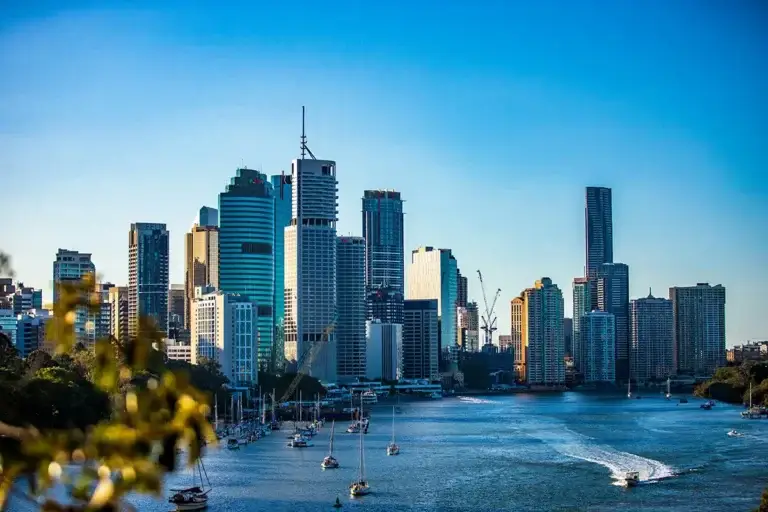
As co-founder of Go1, Dr Tran helped build one of Australia’s most successful tech companies, scaling a Brisbane startup into a global success story. Now as co-founder and Chief Operating Officer of Brisbane-based Black Sky Industries, he applies that same belief in execution to a very different challenge of building sovereign propulsion capability aimed at global markets.
“Like any good Australian defence company, we are focused on exporting to the world, and that is what we should be doing because Australia is a tiny market in the grand scheme of things,” Dr Tran said told OpOz. “I think Australia and the ADF should always be an Australian company’s best customer, but it shouldn’t be our biggest, and if we take that sort of mentality we will be able to have a sovereign industry that’s going to thrive.”
Growing local capabilities
As global supply chains strain and geopolitical tensions rise, the idea of sovereign capability has shifted from policy jargon to practical necessity. For companies like Black Sky Industries, that has morphed speculative conversation into its business model with the company’s considerable expansion in recent times. And that expansion comes hot on the heels of several million in government grants, as well as contracts from defence industry.
“We’ve quadrupled our team to pretty much 50 now, and we’ll probably look to grow that team two or three-fold in the next 18 months, so that gives you an idea of the sort of trajectory we’re on,” Dr Tran said. “We’re excited by the fact that government recognises the importance of sovereign manufacturing capability, and it’s very pleasant to be named by the government as one of those vendors.”

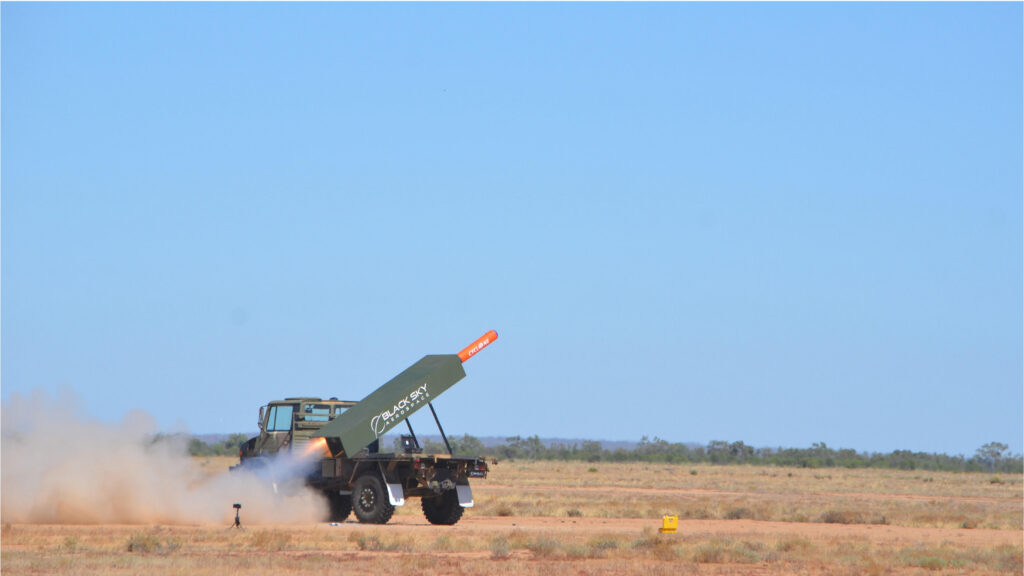
Black Sky Industries operates under a broader umbrella than its original aerospace identity of Black Sky Aerospace, reflecting that the company now sees itself as more than a niche player in this market. Its core work – or “bread and butter” – sits in propulsion, specifically rocket motors, but it’s role is best understood in Dr Tran’s own analogy.
“We’ve always thought of ourselves as supplying the picks and shovels, whether that’s to the defence industry or to the space industry, we think we’ve got a really important role to play there,” Dr Tran said.
Rather than competing in the space race to launch payloads into orbit, the company focuses on suborbital capability – or launching rockets about 100km into the air to the edge of space to test equipment. Those systems are critical for testing everything from defence technologies through to healthcare. It’s a different part of that ecosystem, but with an incredibly important role, particularly with an eye on the future to build data centres in space, Dr Tran says.
Black Sky’s business model also challenges the traditional idea of research and development, as there’s no single product-launch moment, but instead constant, embedded and commercial work for their customers.
“R&D is actually part of our bread and butter and we’re constantly iterating on different motor types for customers across all sorts of industries,” Dr Tran said.
That approach enables the company to be nimble and adapt to different customer needs. It also reflects how more manufacturing businesses are focusing less on creating a single flagship product and evolving into continuous capability development.
For Dr Tran, however, the conversation always returns to sovereignty, what that means practically, and breaks it down into three layers. Is it made here in Australia? Does the intellectual property reside in Australia? Do we as Australians have autonomy over what we do with that IP?
His definition is shaped by both strategy and experience, from the lack of medical supplies during the Covid pandemic, and the current fuel and fertiliser shortage Australia faces from the US/Iran conflict. Outside of aerospace, Dr Tran also continues his work as general practitioner, and it is that experience that shapes his thinking.
“During COVID, I couldn’t get rubber gloves or masks, so, from my perspective, I always come back to the fact that Australia has been there very recently in terms of what it means to not have stuff that we need, and the answer is, the more we can make here, the better off we will be,” Dr Tran said. “I think countries are realising that their reliance on other countries comes at a risk.
Focused on a positive future
Despite growing global conflicts and shifting alliances, he remains firmly “glass half full” when it comes to Australia’s prospects. Funding is improving (not abundantly) but it is moving in the right direction. And regulation, which is often seen as a barrier, is in some ways an advantage, especially in Queensland, where he says expertise from industries such as mining translates into aerospace and propulsion. Workforce skills from the engineering and technology sectors could also be utilised.
Challenges do exist through, and are probably most visible in the procurement space, as governments that are wary of using taxpayer funds, tend to focus on established companies rather than those that are emerging.
Dr Tran analyses the government mindset in simple terms, saying most buyers will choose the equivalent of the tried and trusted “Toyota Corolla” over something new, despite the possible long-term advantages of buying from those newer companies. That mentality creates a risk in failing to invest in what comes next.
The result is that without those opportunities to prove themselves, smaller companies struggle to have the track record to compete at scale with the multinationals.
For Dr Tran, a successful domestic sovereign defence industry is not one that just meets domestic needs, but one that grows the domestic economy – contributing jobs, generating IP and exporting globally – creating not just capability but sustainability.
In a sector that demands persistence, capital and resilience, it is that mindset, more than any piece of technology, that could ultimately determine if Australia succeeds.