Workforce shortages across Australia’s health and social care systems are increasingly linked to structural barriers within education and training pathways, particularly where mandatory placements impose financial strain on students. Calls to extend financial support to a broader cohort of health students reflect concerns that current settings may be limiting access to critical professions and affecting the capacity of essential services, especially in regional and high-need areas.
Federal politicians warn the next generation of Australia’s health workforce will suffer financial hardship unless the Federal Government extends payments to all students.
Nursing, midwifery, teaching and social work students were granted payments under the Commonwealth Prac Payment scheme introduced last year, while other allied health and medical students missed out.
However Independent Member for Indi, Dr Helen Haines MP, and ACT Independent Senator David Pocock released new Parliamentary Budget Office costings at a press conference in Canberra that showed extension of those payments to other health students would have a minimal impact on the federal budget of $290 million over the four years of the forward estimates.
“Unpaid mandatory placements are pushing thousands of students into financial hardship at a time of acute workforce shortages and a cost-of-living crisis,” Dr Haines said.
“These costings show that ending placement poverty is both achievable and affordable. Failing to act is a political choice, not a budget constraint.
“At a time of severe health workforce shortage, particularly in rural and regional areas, the government can’t afford to let unpaid placements become the barrier that stops students from completing their degrees.”
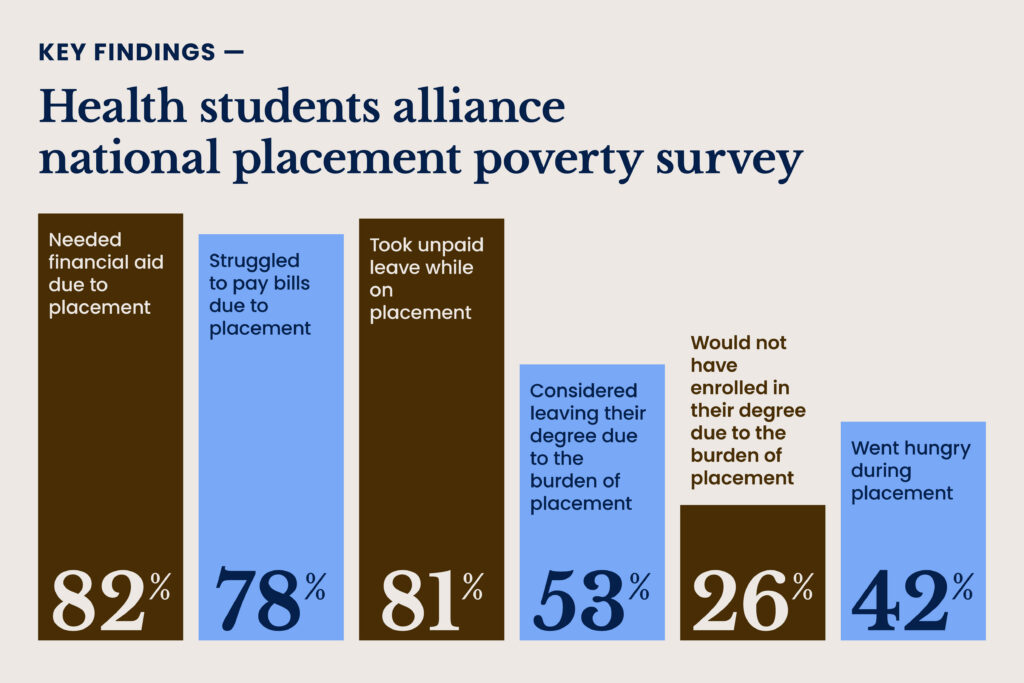
The Parliamentary Budget Office costings coincide with the release of new survey data from the Health Students Alliance, showing 42 per cent of students were going hungry while on placement.
“Extending Commonwealth Paid Prac to enable more Australians to qualify in the professions we so desperately need makes sense and will help ease that shortage,” Senator Pocock said.
“Over the longer term, it will cost the federal government more if they fail to support the pipeline of medical and allied health students Australians right around the country rely on.”
Dr Hains and Senator Pocock, together with advocates and other crossbench colleagues, are pushing for the payment to be expanded in line with the recommendations of the Universities Accord Final Report.
CEO of Allied Health Professions Australia, Bronwyn Morris-Donovan, said extending the Commonwealth Prac Payment to allied health students was not optional – it was essential.
“Unpaid placements hit hardest for rural students, mature-age students with caring responsibilities, Aboriginal and Torres Strait Islander students, and anyone experiencing financial disadvantage,” Ms Morris-Donovan said.
“Expanding [Commonwealth] Prac Payments is crucial for building a more diverse workforce and ensuring every student has a fair chance to complete their training.
“We welcome the support of MPs standing with us. Addressing this gap in Commonwealth Prac Payments is a practical, immediate step the government can take to strengthen the pipeline of allied health professionals Australia urgently needs.”
Dr Haines and Senator Pocock also partnered with peak body Allied Health Professions Australia to launch an online petition calling on the federal government to expand the Prac Payment Scheme.