Veteran and first responder wellbeing programs are increasingly exploring non-clinical approaches that focus on connection, self-regulation, and identity beyond service. Equine-based models, in particular, highlight how experiential environments can provide immediate feedback, build trust, and support behavioural change in ways that differ from traditional treatment pathways.
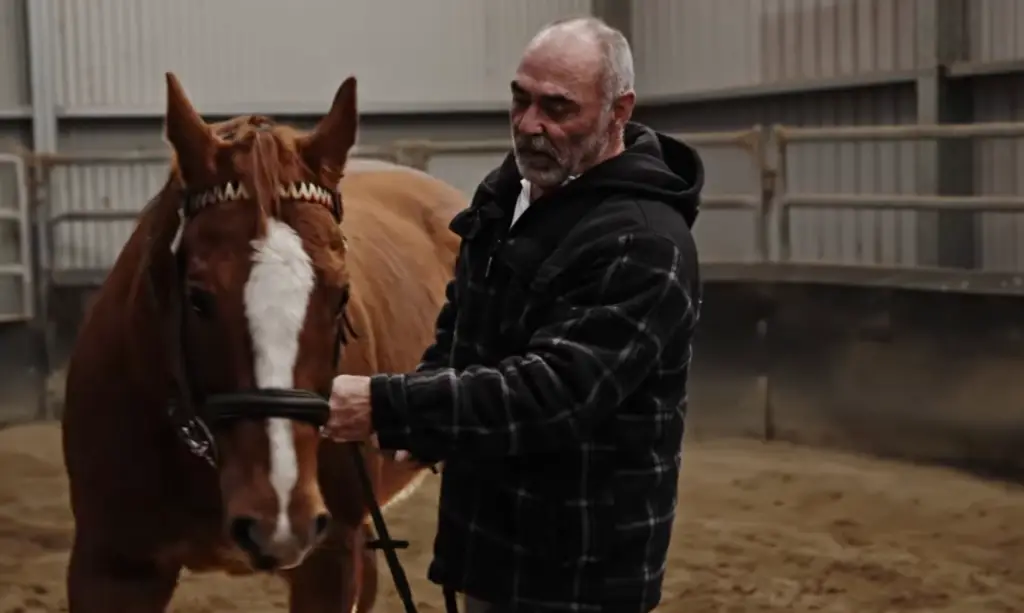
On the third morning of a Horse Aid residential, the arena is quiet except for the sound of hooves shifting in the sand. A former first responder stands in the middle of the paddock, holding a lead rope that connects him to a thoroughbred who once thundered down racetracks.
He has already startled the horse twice. His movements were sharp, his voice carried too much edge, and the animal flinched away. Scott Brodie, watching from the rail, steps in gently. “That is more energy than you need,” he tells him. “Slow it down.”
The man pauses. He tries again. This time he softens, his shoulders drop, and his breathing steadies. The horse stops reacting and begins to follow him calmly around the arena.
Afterwards, he looks up at Scott with a kind of surprise. “That’s what I do in life,” he says. “I get nervous, then I get abrupt, and everything falls apart.”
In that moment, the horse has told him something no one else had been able to say in a way he could hear.
This is how Horse Aid works. Not with lectures or diagnoses, but with honesty.
Where the idea first took shape
Horse Aid began in 2015 after Scott, a former mounted police officer, heard about equine-assisted work being done with veterans in the UK. A friend had property in Kangaroo Valley and suggested they try something similar in Australia. They invited a small group of veterans from around the country to take part in a pilot program.
Scott did not set out to build a national charity. He thought they might run one program and see where it took them. What happened was immediate.
Veterans who had barely left their homes for years turned up. Men and women who felt they had nowhere else to fit in found themselves standing beside people who understood without explanation. Once they entered the arena, the horses responded in ways that cut through defensiveness and pride.
“It was really clear, really quickly, that the veterans were receiving a lot from the experience,” Scott says. He has worked with horses his whole life; what surprised him was not the horses themselves, but how powerfully the parallels between horse and human surfaced in this context.
Trained for a purpose, then set adrift
Horse Aid works exclusively with veterans and first responders. The horses are almost all off-the-track thoroughbreds. The connection is deliberate.
Thoroughbreds are trained for a single, intense purpose. They live within a structured system and, when their racing careers end, much of what they learned no longer applies. Some carry physical injuries and others carry behavioural patterns that need careful retraining.
Veterans and first responders often recognise themselves in that description. “We’ve taken horses that have got baggage, the same as the veterans and the first responders have baggage,” Scott explains. “Some of that baggage is going to be there forever. It just needs to be managed.”
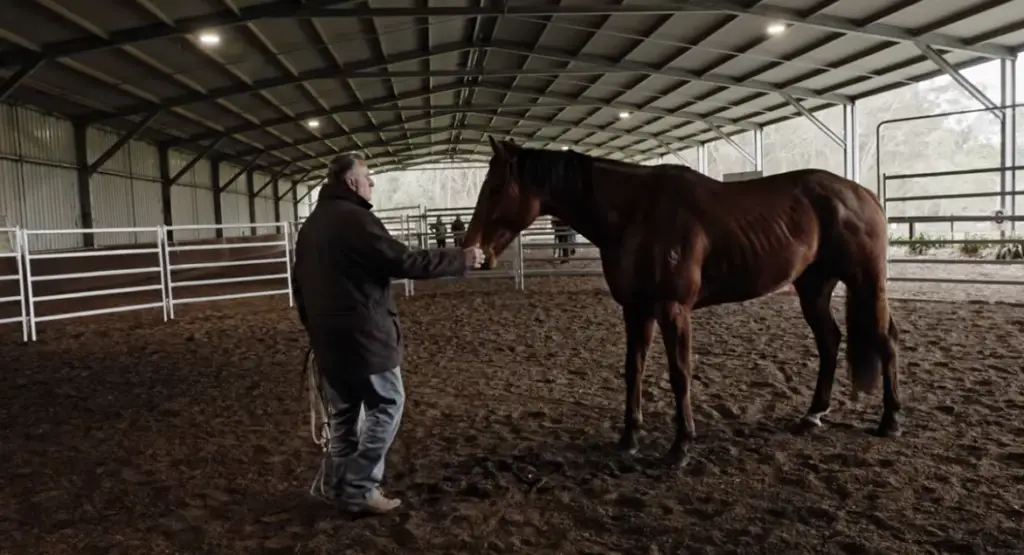
In the arena, that recognition happens quickly. The horses are sensitive and intelligent, and they react instantly to tension, hesitation, or aggression. They also respond immediately to calm, steady leadership.
“Horses crave leadership,” Scott says. Not dominance, but clarity. It’s a lesson that transfers to participants who quickly begin to see how their own energy shapes the world around them. When they overdo it, the horse withdraws or reacts. When they settle, the horse settles. When they try too hard, nothing flows. When they do only what is needed, the partnership clicks.
For people who have spent careers serving others, often in high-adrenaline environments, that feedback is powerful because it is clear, immediate, and free of judgment.
A place where service continues
Horse Aid is not clinical therapy. Anna Schibrowski, who joined to help formalise and expand the organisation, is careful about that distinction. “We can’t really use the term ‘equine therapy’,” she explains, because the horses are not therapy horses in the traditional sense.
Many are still in retraining, and so the work is grounded in horsemanship, skill-building, and structured experience.
What participants gain comes through several layers. They learn practical horsemanship skills, which builds confidence in people who often feel they have lost their competence. They experience mindfulness because, in the arena, distraction is impossible. They practise self-regulation because the horse mirrors their internal state.
They also find community.
When Horse Aid runs a five-day residential, around a dozen participants live and work together. Volunteers return to help, many of whom are past participants. Conversations begin casually and deepen as trust builds.
Scott has seen what that environment can unlock. One man attended a one-day program and returned weeks later for a residential. He told Scott something that stopped him in his tracks. “I can read again,” he said.
For years, he had been unable to concentrate long enough to lose himself in a book. After learning to slow himself down in the arena, he realised he could re-enter the present moment. Reading came back. It sounds small, but it isn’t.
The gap before the cliff edge
Most participants arrive at Horse Aid after leaving service. Many are in the process of medical discharge, or are medicated, and some have even been hospitalised. Scott believes strongly in reaching people earlier. “Prevention’s better than cure,” he says.
He has worked with defence rehabilitation groups while members were still technically serving. At that point, they have acknowledged something is wrong though have not yet fallen into crisis. He sees that as a critical window.
The difficulty lies in recognition. People who have spent their lives serving others are not accustomed to asking for help. “That step to say, ‘I’ve got a problem’, is a massive step,” Scott reflects.
Anna sees the pattern too. She recalls a period when large numbers of women in their mid-thirties were leaving frontline roles in broken states. They had been invested in, trained, promoted, and then found themselves unable to cope and unsupported at the point they most needed stability.
The cost is human first. It is also financial. A five-day residential at Horse Aid costs around $22,000 to run for up to twelve participants. Hospital admissions and long-term compensation claims cost far more.
Horse Aid operates largely on grants, donations, and community support, and everyone involved is effectively volunteering time and expertise. The question of why early intervention is not systematically funded remains open.
Leadership in the sand
For Scott, service did not end when he left the police; it simply changed shape.
Each morning, he rides his own horse before beginning work. That discipline and passion anchored him during his career, and he believes strongly that anyone working in high-pressure service roles needs something beyond the job itself that provides identity and fuels passion.
In the arena, he often talks about leadership. Not the kind defined by rank, but the kind that steady horses recognise as strong, fair, and consistent. Participants discover that they can still lead, guide others, and build trust.
The horses, many of which might otherwise have uncertain futures, also find a second purpose. Their racing careers may be over, but their sensitivity becomes an asset, and their past training becomes the foundation for new work.
Heroes and horses meet in that shared transition: both have been trained for intense service; both carry history in their bodies; and both need space to redefine what comes next.
Second chances, side by side
Horse Aid now aims to run multiple residentials and one-day programs each year, with capacity to reach close to a hundred participants annually if funding allows. It’s a small number compared to the scale of need and is life-changing for those who attend.
The impact is visible in quiet ways. In a man who leaves the arena smiling because he has finally recognised a pattern that has shaped his life. In an individual who rediscovers reading. In volunteers who return, not because they have to, but because the sense of purpose remains.
Horse Aid exists because Scott saw a gap and chose to act. It continues because Anna and a small community believe that healing can happen in places that look different from hospital wards and consulting rooms. There are alternative ways to heal.
Sometimes they begin with a lead rope, a steady breath, and a horse who tells the truth without saying a word.