Government procurement is expanding access for underrepresented business groups. Queensland’s decision to include veteran-owned and veteran-supporting businesses creates new opportunities across multiple sectors, but also reflects a basic challenge: government lacks clear visibility of how many of these businesses exist and what they can deliver.
The Queensland Government has thrown open the doors to veterans through a new procurement policy to encourage agencies and contractors to work with veteran-owned and veteran-supporting businesses.
The Deputy Director-General of Queensland Government Procurement, Andrew Bennett, said the new policy (an Australian first to include veterans) was now facing a challenge that only veterans could help solve.
“We don’t know who the businesses are,” Mr Bennett told a veteran business forum. “We don’t know what you’re capable of until you respond to an opportunity, so come and see us. This policy is all about the opportunities that government wants to make available to you.”
For veteran entrepreneurs looking to work with government, the message is clear: engage early, register your business, and make yourself known to procurement teams as the government does not know how many veteran-owned businesses exist in Queensland.
“I can’t put my hand on my heart and honestly say how many veteran-owned or veteran-supporting businesses there are in Queensland today, which is a challenge for us,” Mr Bennett said.
In a bid to address that, the government has commenced work with Veterans’ Affairs and other agencies to develop a credential system that will confirm the identity of veteran businesses.
“I want to see the number of businesses that identify as being owned by or supporting veterans increase,” Mr Bennett said.
Veteran businesses are now embedded in Queensland’s procurement framework through what the government calls “purposeful public procurement outcomes.”
“Businesses owned by veterans, or that support the transition of veterans from serving to civilian employment, was pretty high up on the list,” Mr Bennett said of the overhaul, which simplified the policy from 700 down to 50 pages.
One of the biggest barriers to government contracting has traditionally been the complexity of procurement rules, and the policy reform was built around a simple mantra: “simpler, faster, better,” Mr Bennett said.
“It was overly complicated, overly regulated, and highly duplicated. I want to make procurement easier. I want to make it happen more quickly because frankly, spending nine months to do a tender is ridiculous.”
Mr Bennett said veterans were a logical inclusion as Queensland was home to the largest veteran population in Australia and the policy enabled government to include those businesses when designing projects.
“If I’m doing a school build in Townsville, I’m probably going to want to select one that talks about providing support for veteran-owned businesses,” Mr Bennett said.
The changes were designed to make government contracting more accessible to small and medium businesses, and one of the biggest misconceptions Mr Bennett encounters is that veteran businesses must operate in defence sectors to work with government.
“A lot of people, when they think about veteran-owned businesses, think defence industry solely,” he said. “With Queensland, this applies to all projects, all contracts.”
Veteran-owned businesses may find opportunities across sectors such as:
- infrastructure and construction
- professional services
- consulting and advisory work
- logistics and supply
- IT and digital services
- maintenance and facilities services.
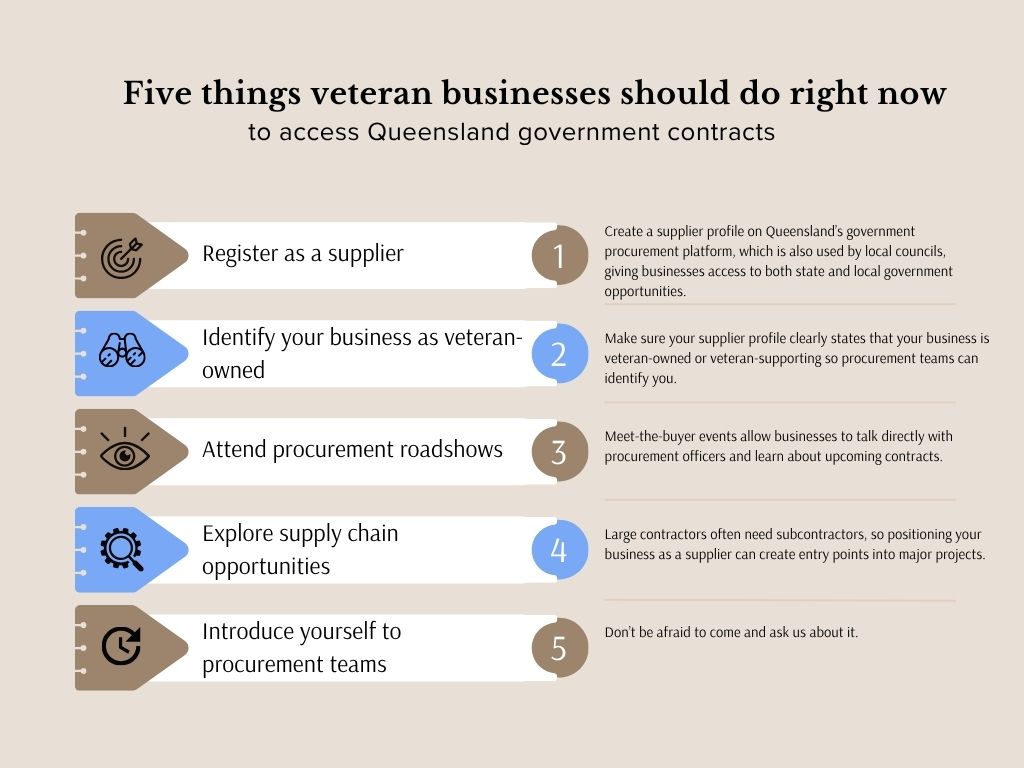
Veteran businesses could also become involved through supply chains by supporting larger contractors working on government projects and could also take advantage of the government’s meet-the-buyer industry events and procurement roadshows.
“These are meet-the-buyer events where businesses can come along and talk to government about what’s happening,” Mr Bennett said.
Queensland Government Procurement usually runs eight to 10 roadshows each year in regional centres across the state, which enable businesses to:
- learn about upcoming contracts
- meet procurement officers
- understand how government tenders work
- explain their capabilities directly to decision-makers.
The revamped policy also encourages larger companies to create opportunities for smaller businesses within their own supply chains.
“We want to take companies that are relatively small and work with them through that period of growth until they’re bigger and more successful,” Mr Bennett said.