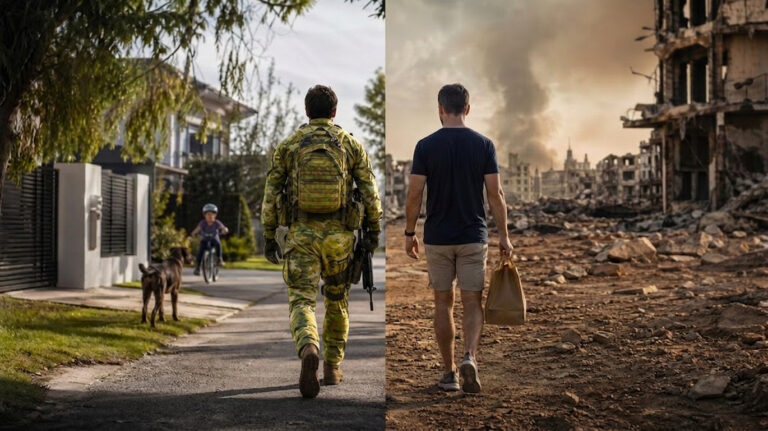
Early childhood behaviour can activate deeply embedded trauma responses in parents, particularly where past experiences of violence or instability remain unresolved. These moments show how quickly learned patterns can resurface under stress, and why breaking cycles of generational trauma requires ongoing awareness, regulation, and deliberate change in how those responses are managed.
When my son was two, he went through a phase of hitting me. If he fell down, or couldn’t get the lid off a bottle, or if I didn’t understand what he was trying to say, he would walk up and slap me across the cheek as hard as he could.
Other mothers reassured me that their kids too had gone through a stage of hitting. That my son would grow out of it. That it was normal two-year-old behaviour.
In my head, I knew that. In my body, it was a different story.
I grew up as the daughter of a Vietnam veteran, in a house where you never knew when the next explosion was coming. My father never received the support he needed to deal with the trauma of his experience, and so it became mine to carry, spilling out of him into me, over and over again.
The smallest misstep—a spilled drink, a wrong look, not coming when called inside the count of five—often ended in violence. His nervous system, wired for the battlefield rather than the homefront, turned my childhood into a warzone.
From traumatised child to new parent
When my children came along, I promised myself I would be an entirely different parent to the ones I knew growing up. I spent decades in therapy processing my experience. I did “the work”. I knew what good parenting looked like and I was ferociously motivated to do things differently.
And then my son slapped me.
The familiarity of that sting opened up old pathways in my brain that derailed my adult self. All knowledge that my son was exhibiting normal two-year-old behaviour was forgotten as I tumbled backward inside my skin, freefalling to the bottom of a long dark well. Looking up through the eyes of my younger self, my son was not my son. He was my father. I was doing nothing wrong and I had been hit.
I could not believe the intensity of the urge I felt to hit back.
All the concepts I had read in parenting books flew out of my consciousness as I fought against the thrashing, pulsing intensity of my body. I was so angry I wanted to punch and kick and scream. With heart hammering and vision blurring I dragged myself away before I repeated the pattern I had learned in childhood with my own child. But only just. And only after I had yelled so loud my son started crying in fright.
I could not believe how hard parenting was.
I had been on a “healing journey” since I read my first self-help book at eighteen. I had spent decades in therapy alongside obsessively researching trauma recovery and mental health. I could not believe after all the years and years of work I had put in that I could feel this undone.
But this is what happens when the amygdala activates and the PTSD response is triggered. My nervous system didn’t consult my rational mind. It went where it had always gone when faced with an attack: straight into fight mode.
This is how the trauma of one generation becomes the next generation’s starting point, and why the pattern can continue from parent to child until someone does the work to stop the cycle.
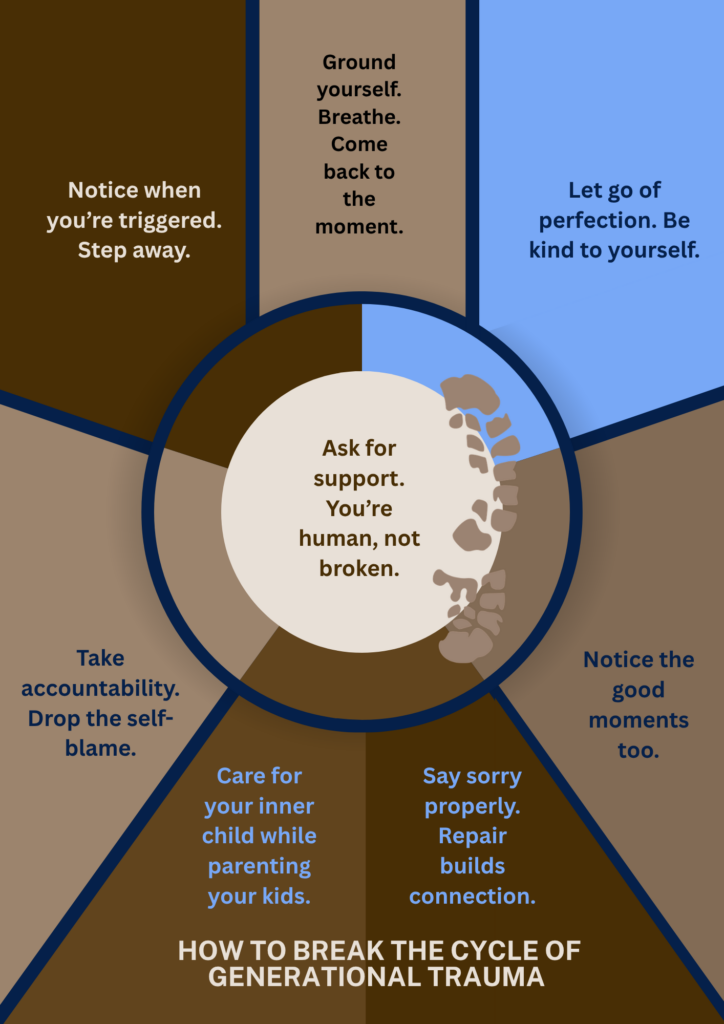
How to break the cycle of generational trauma
There is no one right way to do pretty much anything in life, but these are things that I have had to learn as a parent who is committed to stopping the cycle.
- Learn to recognise when your nervous system has become activated and walk the hell away.
- Learn how to ground yourself through your body, breathing exercises and present moment awareness.
- Learn to be a good parent to your own inner child as you parent your kids (hint: stop being so mean to yourself).
- Stop expecting yourself to be perfect and be kind to yourself when you are struggling.
- Be accountable for your actions if you lose it at your kids, but don’t buy into the stories saying you are the worst person in the world (always remember trauma is a drama queen).
- Learn to say sorry properly. Not sorry, but. Just sorry. Say it as often as is needed. (Repair is how real and lasting connection is built).
- Remember to pay attention to all the positive moments happening with your kids as well.
- Accept that you might need support to do all these things and that doesn’t make you broken, it makes you human.
If you are working hard to parent your kids in a different way then you were parented, if you are managing your own mental health challenges while parenting, if you are determined to do what it takes to break the cycle, I see you, I am you and I send you much love.