Senate Estimates hearings continue to provide one of the most detailed public examinations of how decisions affecting veterans are made, funded, and implemented. Through direct questioning of departmental officials, senators are testing the assumptions, evidence, and consultation processes underpinning major policy reforms, often revealing details that were not apparent when measures were first announced. As scrutiny intensifies around proposed changes to veterans’ allied health funding, the hearings have exposed growing concern among senators about the balance between budget savings, policy design, and the practical impact reforms may have on veterans who rely on ongoing care.
The federal government’s plan to impose a $5,000 annual cap on allied health services for veterans is shaping as one of the most contentious elements of the federal budget, with senators warning it risks stripping care from those who need it most as the government targets a small number of rogue providers and banks nearly a billion dollars in savings.
The new policy came under intense scrutiny in Senate Estimates, with officials conceding the policy was introduced without prior consultation and key details of how it will operate remain unresolved.
The cap, due to begin in July 2027, will limit how much veterans can spend on allied health services such as physiotherapy, psychology and exercise physiology before needing additional approval, despite the approval process not being finalised.
While the Department of Veterans’ Affairs (DVA) argues the measure is designed to improve “treatment effectiveness” and curb overservicing (referred to as sharp practices), estimates hearings revealed consultation with veterans will not begin until August, months after the policy was locked into the federal budget.
That sequencing has alarmed senators and veterans alike, particularly given the scale of the change, the absence of a defined pathway for those who will exceed the cap, and the possibility that veterans with chronic and complex conditions could be left high and dry.
Australian Greens Senator David Shoebridge said the lack of consultation, plus no mechanism for going over the cap had sent a cold shiver of fear up his spine.
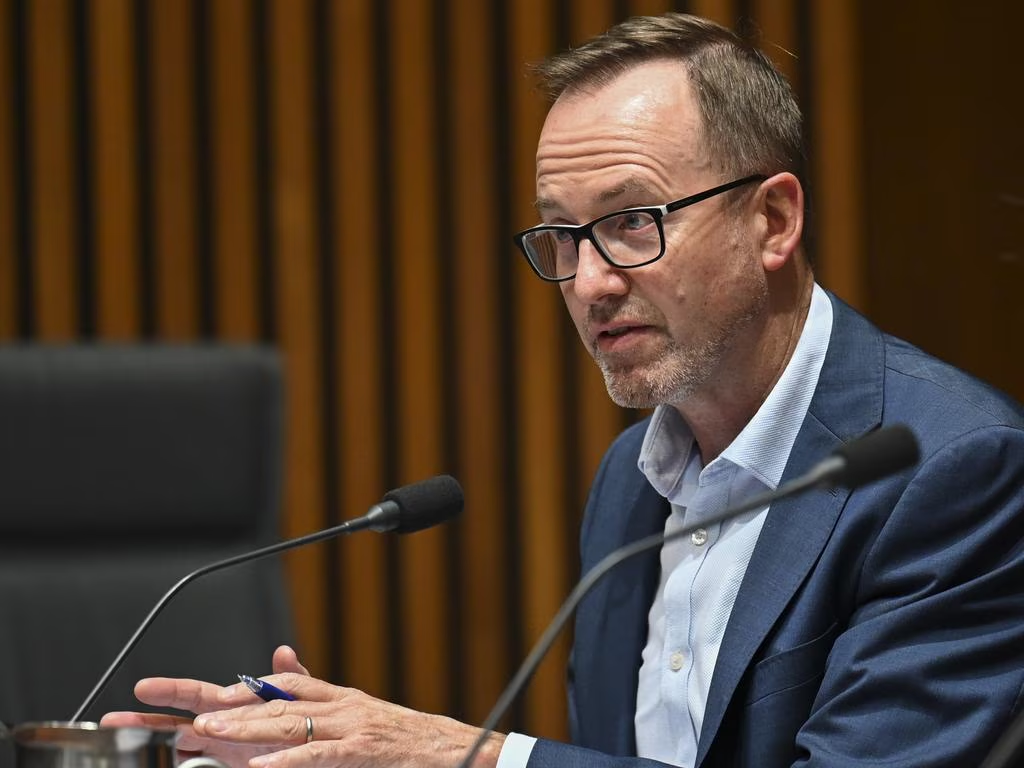
“I reckon this whole committee would have been on board with you if you’d come and said we’re going through a consultation process, we’re crunching the data, we’re finding out which providers are potentially exploiting the system, and we’re going to target those providers,” Senator Shoebridge said.
“We’re going to do everything we possibly can to prevent funds leaking out to providers who are overservicing, and, when we find them, we’re going to put a black mark on them and they’re never going to get access to DVA again.
“You’re actually targeting the veterans, and you’re putting these hoops and these barriers to prevent the veterans getting the service [and] every time you do that, what I hear, and what anyone who talks to veterans hears, is that it’s a disaster for veterans.”
DVA Secretary Alison Frame confirmed the process for accessing care above $5,000 had not yet been designed and would instead be developed through a post-budget consultation process.
“I have explained that we are consulting on that from August this year extensively … town halls, a submission process [and] veterans will have an opportunity to write and say what they consider it should be,” Ms Frame said.
“I’m sure peak bodies will write and suggest how they think it should operate, we have committed publicly to a full consultation process around that, so we do not have the answers to that question today.”
At the same time, DVA officials defended the policy by pointing to cases of excessive billing within the system, including instances where veterans were recorded as receiving near-daily treatment across multiple providers, including one case where more than $150,000 was spent on a single individual in a year. However, further questioning revealed that roughly 25,000 veterans – out of more than 300,000 – currently exceed $5,000 a year in allied health services, placing a significant cohort directly in the path of the cap.
That figure has become central to the debate, because while the government maintains the cap is about targeting “sharp practices” by a small number of providers, senators questioned why a policy potentially affecting hundreds of thousands of veterans was being justified by a relatively narrow set of extreme cases. The concern is that those who rely most heavily on allied health, often veterans with complex physical and psychological needs, would bear the brunt of the changes.

Nationals Senator Ross Cadell questioned whether the measure was a response to genuine overservicing or a budget-driven decision to find savings, before turning to the broader impact on veterans.
“You’re getting 300,000 veterans, and you’re saying you all suffer because one person’s giving $101,000 worth of dietary advice,” Senator Cadell said.
DVA Deputy Secretary, Policy and Programs, Andrew Kefford PSM said most veterans actually did fall below the threshold and that issues had been addressed at the provider level.
“The majority fall under the $5,000 threshold,” Mr Kefford said.
“To the extent that there have been integrity measures rather than overservicing, there have been significant measures taken by the department to deal with overservicing by individual allied health providers, including through the court process as well as administrative processes.”
The financial framing of the policy has only deepened those concerns with budget papers showing the government will spend about $169.7 million over five years to increase allied health provider fees and remove the existing 12-session treatment cycle. It is a move intended to improve access and reduce administrative burden, but alongside that investment sits a projected saving of $748 million over three years tied to the introduction of the cap.
Senators repeatedly pressed officials on how such a large saving could be achieved without significantly reducing care, particularly for high-needs veterans.
Senator Shoebridge said the government was taking a “chainsaw” to the veterans’ budget.
“You champion putting in an extra $169 million over five years for allied health services and then, literally on the same page, talk about how you’re pulling three-quarters of a billion dollars from the same services over just three years, how is that a good news story for veterans?” Senator Shoebridge said.
While DVA pointed to overservicing and inefficiencies in the system, it declined to provide detailed modelling underpinning the savings, citing cabinet processes. Officials did acknowledge, however, that the figures draw on assumptions about current usage patterns and instances where services are deemed ineffective.
“We will not be discussing details of the modelling … because that is not typically what is provided [because] it’s part of the cabinet consideration,” Ms Frame said.
LNP Senator Paul Scarr demanded that DVA provided the estimates committee with the modelling on the budget figures.
“This is budget estimates. There is a figure in the budget that says $748.9 million, and we’re asking how that figure was calculated, I can’t imagine anything more within the realm of budget estimates than asking how a figure in the budget across the forward estimates is calculated.”
Tasmanian Senator Jacqui Lambie said “the word is” DVA was told to find savings in allied health as a trade-off for the increase in allied health provider fees, taking “from one hand and then gave it to the other”.
For veterans already navigating complex treatment pathways, the lack of clarity about what happens beyond the cap is proving deeply unsettling.
Estimates heard that while most veterans fall below the $5,000 threshold, those who exceed it are often managing chronic pain, mental health conditions or rehabilitation following serious injury – cases where treatment intensity can spike rapidly and unpredictably.
Compounding the uncertainty is the reality of existing delays within the system. Evidence presented during the hearings showed approval times for certain health-related reimbursements have blown out significantly in recent years, raising questions about how a new layer of approvals would function in practice.
Senator Scarr raised concerns about delays in approvals for veterans seeking to exceed the $5,000 cap, questioning how DVA would mitigate the risk to their health.
“If you’re dealing with complicated cases involving psychological support, pain management support or physical therapy, for which those decisions are time critical, how are you going to militate against the risk that a veteran bumps up against this $5,000 cap and there’s an interruption to the continuity of treatment, which has devastating health consequences on a veteran?” Senator Scarr said.
While DVA has pointed to planned system improvements and a shift toward more automated processes, those reforms are not yet in place.
What emerged from estimates was not just a policy under scrutiny, but a process that appears inverted, with a major structural change announced first, with consultation and design to follow. For many veterans, that has translated into anxiety about access to care, particularly in the absence of clear safeguards for those who will inevitably exceed the cap.
With consultation still months away, and the Senate yet to pass the measures, the $5,000 cap remains far from settled, with the hearings exposing a tension about whether a reform framed as improving access and accountability will, in practice, limit care for those who need it most.