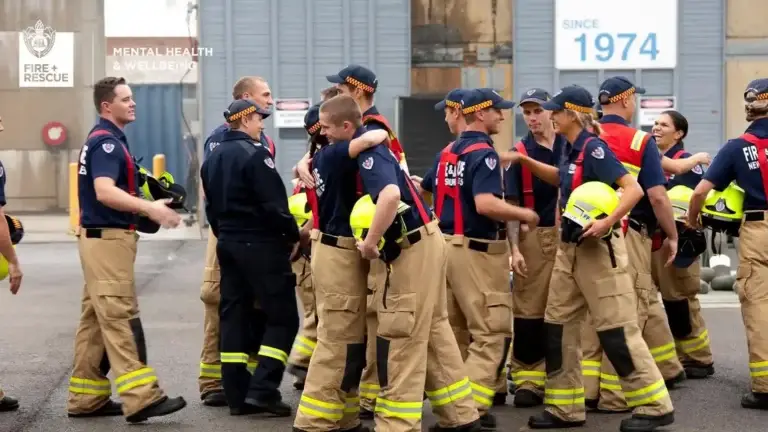
Loss of physical capability often raises questions about identity, career continuity, and long-term contribution, especially within military and operational communities where roles rely on physical performance and independence. Experiences like vision impairment test how institutions and individuals adapt, while also highlighting pathways into continued service and redefined purpose.
Tunnel vision is not good for many things, like driving, for one. Peripheral awareness disappears quietly, long before you realise how much you rely on it. But tunnel vision is also a form of focus, and for Taryn Dickens, focus became the unexpected gift hidden inside loss. Her world narrowed, but her life did not.
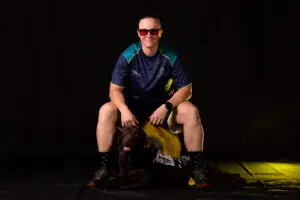
As her sight constricted, Taryn reached new heights in international para-sport, reshaped her career in the Royal Australian Navy, and built a life grounded by her wife Dee and her service dog, GiGi. What could have been a retreat instead became a decision about exactly where energy, effort, and purpose belonged.
“The best part of my life was being told I was going blind,” Taryn told John Coutis on his podcast More to Me. “I instantly just had purpose and I was quite lost before that.
“I was a new Navy sailor and had a career but I was in a big pond full of lots of fish, and I was trying to work out how to make the world around me a better place.”
The diagnosis did not arrive with drama, but with a migraine. After two and a half years in the Navy, in 2019, Dickens experienced her first migraine and remembers thinking, “this is interesting.” It was the first signal that something fundamental was changing. Further investigation revealed Cone-Rod Dystrophy, a degenerative eye condition that would progressively erode her vision.
Her doctor framed it plainly: This was a life sentence, not a death sentence, and Taryn took that sentence literally.
Rather than stepping away from the world she knew, she doubled down on it. She continued working in the Navy, already competing in endurance cycling events as part of the Australian Defence Force cycling team. Where uncertainty might have caused hesitation, Taryn responded with precision, refining how she trained, worked, and lived.
Born and raised on Brisbane’s northside, Dickens describes herself as an Army brat. As the daughter of a rugby league player, she was shaped early by discipline and movement, but at school she was also voted class clown and most likely to drive a garbage truck, an early hint that conventional pathways were never going to hold her attention for long.
She joined the Navy at 34, later than most. Before that, she had tested herself in environments that demanded resilience rather than comfort. After a teenage job in a takeaway store, she worked in a car mechanic’s workshop in suburban Brisbane, prompted by being ripped off for spark plugs. She credits that job with setting the foundation for everything that followed.
She went on to become a fitter and turner for Brisbane City Council in wastewater treatment, which she refers to dryly as “a poo farm,” before taking a drilling job in Mongolia in 2008. Living in a yurt and working alongside men who had never shared a worksite with a woman proved unsafe, and she returned home.
Back in Brisbane, a job in a cycle shop opened the door to competitive cycling. A stint as a baggage handler for Virgin followed, but the pull toward military service never faded. With trade qualifications and international experience behind her, she enlisted in the Navy as an electronics technician, trained at HMAS Cerberus, and was posted to HMAS Kuttabul in Sydney. “I wanted something that I could make a career of,” Taryn said. “I was going to enlist earlier in life but I wasn’t ready.”
And then of course, everything changed. If the diagnosis itself was not the breaking point, driving was. Ironically, the deepest heartbreak came not with being told she was going blind, but with handing in her driver’s licence. The moment arrived in Canada, where Taryn was classifying as an international athlete. Mandatory eye testing raised a confronting question.
“Well, no-one has beeped at me,” she quipped at the time.
“That gave me a really big fright in that [at that time] I was actually allowed to drive 15km from my house in familiar environments.” Canada was where she learned she would classify as a B3 visually impaired athlete. It was also where she realised her independence was slipping away faster than she had acknowledged.
“When I got home from Canada my wife picked me up from the airport and I said we’re going straight to the transport department and I handed my licence in then and there,” Taryn said.
“I lost a lot that day, but it felt pretty powerful to be able to do that myself, instead of having them take it. I’m not allowed to drive because if I mess up, I will kill people,” she said.
“My vision loss is tunnel vision, so your brain actually fills in what it thinks is still there. There was a crossing that I drove past every day and I never see anyone at that crossing, so if one day I drive there and someone is there and I don’t see them, it just wasn’t worth it.”
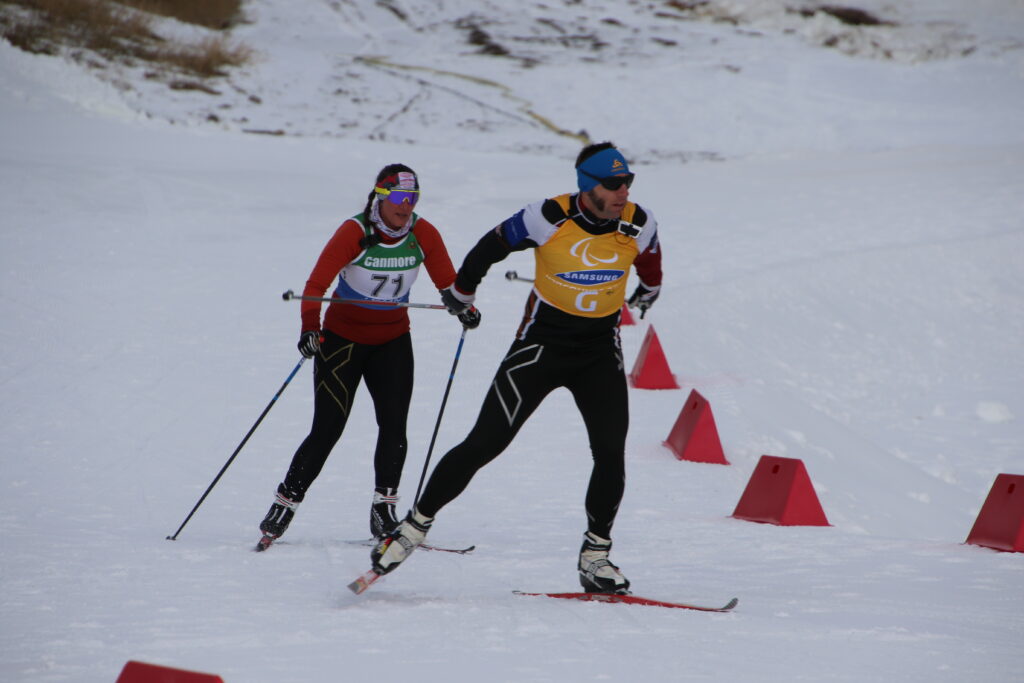
Yet, what tunnel vision took from her on the road, it gave back to her on snow. In her late thirties, Taryn turned to cross-country skiing and biathlon, a sport that combines Nordic skiing with precision shooting. Uphill skiing requires a guide, and the rifle contains no rounds, instead using infrared technology designed for vision-impaired athletes, translating accuracy into sound. “It’s real cool,” she said.
“I go absolutely nuts on the snow, then come in and lay down and chuck a headset on, then pick the rifle up and target. It sounds like the reversing camera on your car, so I kind of feel like I’m still driving a bit.”
In early 2025, Taryn made her World Cup debut. She did not qualify, and she speaks about that without defensiveness. “It’s not even been three years that I’ve skied so I’m very happy where I’m at,” she said. “It would have been good and would have made this year easier if I had made the qualifying times, but this has also kept me honest with my training as I need to keep going up.”
Today, Taryn works full time in the Navy in Canberra and trains relentlessly, supported by Dee and grounded by the steady presence of GiGi. Visibility has brought attention, but also responsibility. She understands that people watch what she does next, particularly those grappling with diagnoses that feel final.
“Now I’ve got this thing that I can show people, that it’s just change,” Taryn said. “The opportunities that I’ve had and the people that I’ve touched and affected, being told I was going blind is the best thing ever.”
At time of publication, Defence does not publish figures on how many Royal Australian Navy personnel identify as having a disability, and there is no publicly available disability breakdown for ADF members. Defence conducts internal workforce census activities, but outputs on disability status are not routinely released. If such figures exist, they would require confirmation or release from Defence under formal information or media channels.