Operational roles, military service, emergency response, and other high-pressure environments often require people to perform effectively while carrying significant levels of stress over extended periods. While resilience remains an important part of that equation, growing research into nervous system regulation, trauma, and recovery suggests that unmanaged stress can accumulate in ways that affect physical health, emotional wellbeing, sleep, decision-making, and relationships long after a triggering event has passed. As awareness of these impacts increases, greater attention is being given to practical, evidence-informed approaches that help individuals actively recover from stress rather than simply endure it.
If you’ve read the first piece in this series, you’ll know about the bucket. The idea that every stressor, every difficult incident, every high-pressure decision, every sleepless night, every thing you absorbed and kept moving through, adds to a load the nervous system carries.
When the bucket overflows, it rarely looks like a breakdown. It looks like snapping at someone over something minor. Feeling nothing when you used to feel something. Not being able to switch off. Reaching for a drink before you’ve consciously decided to. Lying awake at 2am with nothing specific on your mind but a body that won’t settle.
So, how do you empty it? First, let’s clear up what doesn’t work.
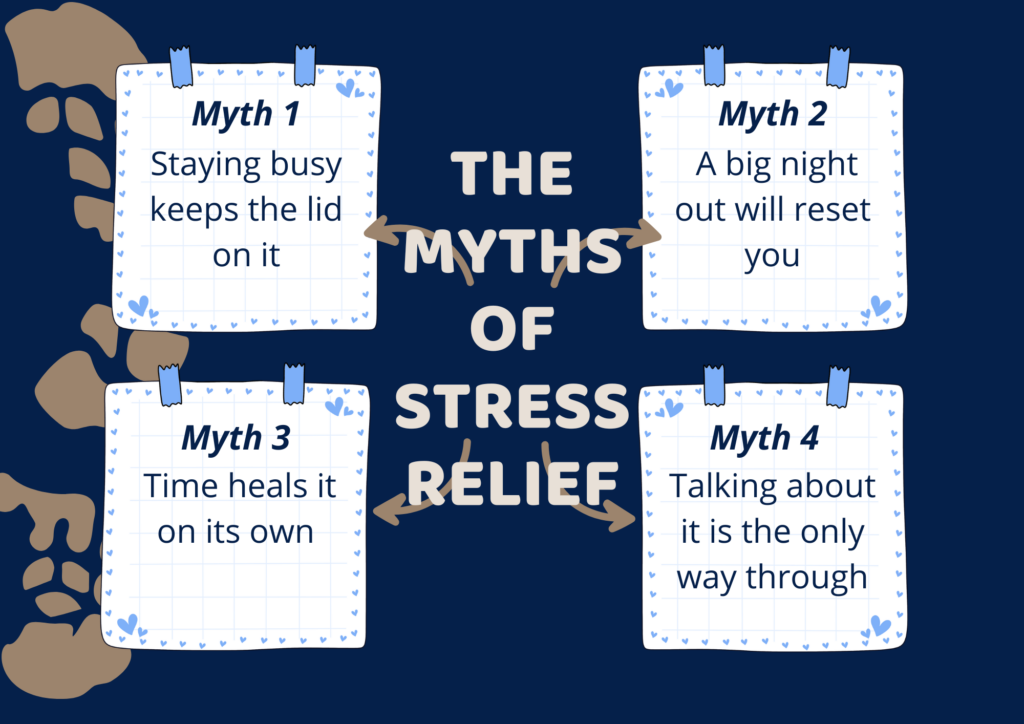
The myths of stress release
Myth 1: Staying busy keeps the lid on it
Keeping busy is one of the most common strategies in this community. If you’re moving, you’re not thinking. If you’re needed, you’re not unravelling. It works… right up until it doesn’t. Busyness delays the processing of stress. It does not discharge it. The bucket keeps filling whether you’re looking at it or not.
Myth 2: A big night out will reset you
Alcohol is a depressant that temporarily suppresses the nervous system rather than regulating it. The night might feel like release. The next day, and often the next week, the nervous system is more reactive, more depleted, and less resourced than before. What felt like emptying the bucket was borrowed time.
Myth 3: Time heals it on its own
Time alone does not process stress. Time plus intentional practice does. Without active discharge, accumulated stress stays stored in the body, in muscle tension, in sleep disruption, in the hypervigilance that becomes a background hum. Years can pass and the body is still carrying events that happened a decade ago.
Myth 4: Talking about it is the only way through
Talking is one pathway. For some people, it’s enormously helpful. But the nervous system doesn’t only process through language. The body holds stress somatically, in sensation, in movement, in the physical residue of responses that were activated but never completed. Some of what’s in the bucket can only be reached through the body, not through conversation.
What actually works
Completing the stress cycle through movement
Stress is a biological process with a beginning, middle, and end. The problem is that modern stressors, and certainly operational ones, frequently activate the response without allowing it to complete. The body prepares to act. The action never comes.
The incomplete cycle stays in the system. Movement, particularly vigorous movement, is one of the most direct ways to signal to the nervous system that the threat has passed and the cycle is complete. A run, a swim, a physical training session. Not punishment. Not performance. Completion.
If vigorous movement isn’t accessible, shaking and tremoring, which happens naturally in mammals after a threat passes, can also discharge held stress from the nervous system. This is the basis of practices like TRE (Tension and Trauma Releasing Exercises). It sounds unusual. It works.
Breathwork as a discharge tool
Slow, extended exhale breathing activates the parasympathetic nervous system and signals safety to the brain. But certain breathwork practices go further, using specific patterns of breath to move stored physiological activation through and out of the body.
This is not the same as meditating or relaxing. Some breathwork is active, even intense. People often feel emotional or experience physical sensation… shaking, heat, tingling… as the body processes what it’s been holding. This is a system completing what it started.
If this is new territory, start with something guided. There are practitioners who work specifically with the service-connected community. The breath is a powerful tool worth learning to use well.
Cold exposure and the physiological reset
Cold water immersion, whether a cold shower, a plunge pool, or open water swimming, activates a rapid physiological response that many people describe as a reset. Heart rate spikes, then drops. Adrenaline surges, then clears. Breathing has to become deliberate.
Beyond the immediate effect, regular cold exposure has been shown to reduce baseline inflammation, improve mood, and increase stress tolerance over time. The research here is growing and robust. It is also practically accessible. A two-minute cold shower at the end of your morning routine is enough to begin.
Time in nature… unplugged and present
As mentioned in previous articles, time in natural environments measurably reduces cortisol and shifts the nervous system out of the scanning, vigilant state. For bucket- emptying specifically, the key is presence. Phone pocketed or left behind, senses engaged with the environment rather than a screen.
Water is particularly regulating. The sound of moving water, swimming in the ocean or a river, sitting near a creek… there’s a reason this community gravitates toward it. The nervous system responds to it in ways that are measurable and real.
Peer connection… the co-regulation effect
Spending genuine time with people who know the culture, where you don’t have to justify how you’re feeling or pretend you’re fine, is one of the most underrated tools for nervous system regulation in this community.
Co-regulation is a real physiological process. Calm, present, attuned connection genuinely shifts your nervous system state. A good conversation with someone who gets it. A meal around a table with people you trust. Sitting quietly with someone who doesn’t need you to be fine.
This is not soft. This is the nervous system doing what it is designed to do… finding safety through safe people.
Sleep as active recovery
Every night of quality sleep empties the bucket in ways nothing else can replicate. During deep sleep, the brain’s glymphatic system literally flushes out metabolic waste, including the byproducts of stress hormones. REM sleep processes emotional memory, reducing the charge of difficult experiences over time.
Poor sleep is not just a symptom of a full bucket. It is a cause. The bucket fills faster and empties slower when sleep is disrupted. Prioritising sleep hygiene, consistent sleep and wake times, a dark cool room, no alcohol within three hours of bed, is bucket maintenance whether it feels dramatic enough to count or not.
The bucket doesn’t empty overnight. And it didn’t fill overnight either. What matters is that you stop adding to it faster than you’re releasing it… and that you have practices, not just intentions.
Pick one. Start tonight. The body knows what to do when you give it the conditions.