Hormonal changes during menopause alter how the body and nervous system respond to stress, reducing recovery capacity and increasing the physiological load carried by women already balancing high demands. In response, a growing range of recovery and regulation strategies are being integrated alongside training to stabilise stress, support cardiovascular and metabolic health, and sustain performance over time.
For many high-performing women, menopause is when pure effort is no longer enough, and resilience becomes the real challenge.
Sleep becomes disrupted, stress feels harder to manage, and the ability to physically and mentally recover declines. Yet, the focus remains on output for many women, rather than recovery and resilience, at precisely the moment when they are needed for peak performance.
When oestrogen declines, the body’s response to stress shifts as cortisol (stress hormone) rises, and the nervous system becomes more reactive. This results in a reduced capacity to absorb and recover from the physical and psychological stressors that affect training, sleep, mood, and overall resilience.
Increasingly, women are turning to targeted recovery tools beyond the gym floor to support recovery and build resilience. These therapies include heat and cold exposure, LED therapy, massage, acupuncture, aromatherapy, compression boots, and meditation, alongside movement-based practices like yoga and Pilates.
Dr Mary Claire Haver, an obstetrician-gynaecologist and menopause specialist, says cardiovascular disease risk increases significantly after menopause, largely due to the decline in oestrogen, which has protective effects on the heart and blood vessels. This makes interventions that support cardiovascular health and stress regulation particularly relevant during menopause.
Dr Andrew Huberman, a neuroscientist and professor of neurobiology at Stanford University School of Medicine, has cited studies showing sauna use is associated with reduced cardiovascular mortality and risk, with benefits observed at temperatures between 80 and 100 degrees Celsius for sessions of five to 20 minutes.
“People who went into the sauna two or three times per week were 27 per cent less likely to die of a cardiovascular event than people that went into the sauna just once a week,” Dr Huberman said. “And, the benefits were even greater for people that were going into the sauna four-to-seven times per week.”
Dr Stacy Sims, an exercise physiologist and nutrition scientist specialising in female performance, cautions that menopausal women may be more heat sensitive, but hot sauna and spa could help to control hot flashes and night sweats.
Cold exposure from cold showers through to ice baths could also help to train the body’s stress response and promote recovery because, as oestrogen declines, women become more sensitive to stress, and cortisol can have a greater impact on the body.
But Dr Sims warns that cold therapy done up to eight hours following strength or resistance training can inhibit some of the strength and hypertrophy gains that one would otherwise experience; however, there was no problem to do it before weights.
Dr Lauren Colenso-Semple, a researcher specialising in female physiology and strength training, told the Huberman Lab she believed the most compelling benefits for women using deliberate cold exposure were mental clarity and psychological wellbeing.
And, you don’t need to be cold adapted to reap the benefits of cold exposure, with just one-to-two minutes in water below 15 degrees Celsius proving effective when done consistently, says Dr Susanna Soberg, a researcher specialising in cold exposure and metabolic health.
“Cold exposure can improve metabolic health by activating brown fat and increasing insulin sensitivity,” Dr Soberg said. “You don’t need a lot of cold exposure to get benefits and 11 minutes per week [in total] is enough.”
These effects may support energy regulation and recovery, which are key factors that become disrupted during menopause.
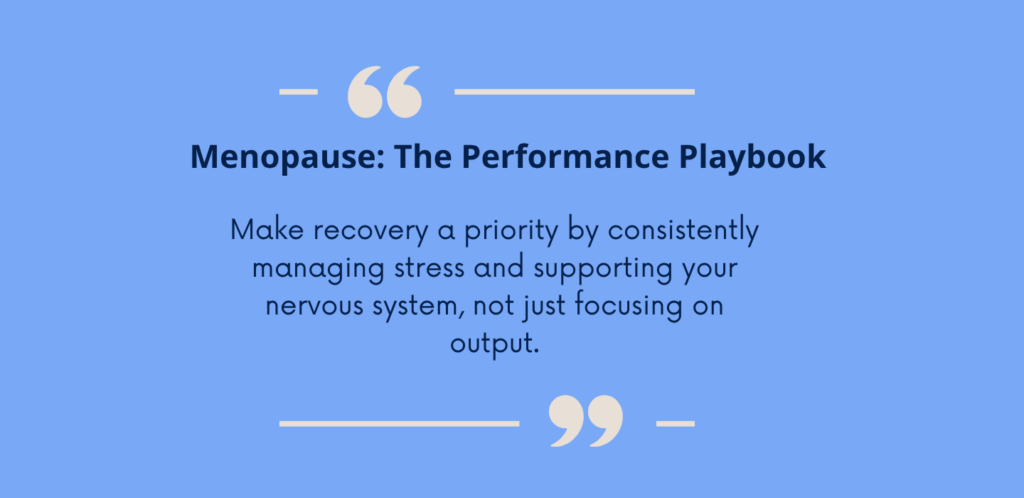
Dr Huberman has said short bouts increase adrenaline and activate the sympathetic nervous system, improving resilience to stress and increasing mental clarity.
Other targeted recovery tools are being used to support circulation, reduce inflammation, and support the body to recover between training sessions. LED therapy, compression boots, and massage are being incorporated into training regimes to support different aspects of recovery.
LED therapy has been associated with cellular repair and reduced inflammation, which may support recovery and energy production at a time when hormonal changes impair tissue repair and increase systemic inflammation during menopause. Dr Andrew Huberman has said red and near-infrared light can support mitochondrial function, which underpins cellular energy and repair.
Pneumatic compression boots are used to enhance circulation and assist in recovery after exercise or injury. Evidence on their effectiveness varies and they are best used as a support tool. As with many recovery tools, including soft tissue massage, they are considered secondary to fundamentals such as sleep, nutrition, and training load.
While physical recovery tools support the body, experts say the most significant shift in menopause is in how the nervous system responds to stress. Meditation is one of the most effective tools to regulate stress and improve focus, sleep, mood, and recovery.
Neuroscientist Dr Wendy Suzuki says studies show that brief daily meditation can have measurable effects on attention, memory, sleep, and mood.
“In our study, participants who meditated for 13 minutes a day showed improvements in attention, working memory, mood, and emotional regulation,” Dr Suzuki said. “You don’t need to meditate for hours, and consistency is more important than duration.”
The simplest form of meditation is to simply focus on the breath and, although your mind will wander (which is normal), the key to the practice is bringing your focus back to the breath, she said.
For those who struggle with traditional meditation, women can try yoga nidra, a form of non-sleep deep rest that can help move the body from a heightened stress state into parasympathetic recovery.
Acupuncture was also found to be helpful for menopausal symptoms, but access is limited and expensive. The results from aromatherapy (and capsules) suggested lavender improved quality of sleep, depression, anxiety, sexual desire, and psychological and physical symptoms.
In menopause, resilience is the foundation that enables women to continue to function at their best. And, in a phase of life where the body becomes more reactive to stress, these practices are not simply wellness tools: they can be used as performance strategies.