
Menopause introduces significant hormonal disruption that affects cognitive function, metabolic health, recovery, and overall performance, yet clinical approaches have historically focused on symptom management rather than system-wide impact. Emerging evidence positions hormone replacement therapy as a targeted intervention that can stabilise these changes and support long-term health outcomes, while also highlighting gaps in access, understanding, and the need for more individualised treatment decisions.
Hormone replacement therapy (HRT) is changing the way menopause is experienced, transforming it from a phase of decline for women into one that can sustain performance, resilience, and health.
As clinical understanding of female physiology evolves, HRT is no longer solely viewed as a last-resort treatment, but as a tool to help maintain strength, cognition, and metabolic function through one of the most significant biological transitions in a woman’s life.
Dr Mary Claire Haver, an obstetrician–gynaecologist and menopause specialist, says many women don’t recognise what’s happening until they look back and realise the shift that began years earlier.
“It’s not just hot flashes, it’s your brain, your mood, your sleep, your metabolism. It’s everything,” Dr Haver said, describing the hormonal fluctuations of perimenopause as the wild west.
In perimenopause, these hormonal fluctuations disrupt the brain’s regulatory systems, driving symptoms such as sleep disturbance, anxiety, irritability, and cognitive fog.
“What we’re doing with hormone therapy is giving just enough oestrogen to calm the brain down, to say everything’s okay,” Dr Haver says, adding that localised treatments, such as vaginal oestrogen, can play an important role in maintaining tissue health and should be more widely used.
Dr Stacy Sims, an exercise physiologist and nutrition scientist specialising in female performance, says this shift has direct implications on how women train and recover.
“As oestrogen declines, women become more stress reactive,” Dr Sims said. “That affects everything, from recovery to how you use carbohydrates, to how your body holds onto fat.”
Where hormone therapy fits
Hormone therapy is not about reversing menopause, but about stabilising the system it disrupts. By reintroducing oestrogen and progesterone (when required) at controlled levels, therapy can reduce neurological instability, support metabolic function, improve recovery, and protect long-term health. HRT becomes a pharmacological tool that helps the body operate more efficiently under new physiological conditions.
The risks
Hormone therapy is not without risk and has been associated with conditions such as blood clots, stroke, breast cancer (depending on the formulation), and dementia in older populations.
However, modern clinical understanding shows these risks are highly dependent on age, timing, formulation, and an individual’s health profile.
Research comparing 1,000 postmenopausal women over several years shows small increases in some risks, alongside reductions in fractures, type 2 diabetes, and colorectal cancer. Most of the early risk data was based on women over 60 using oral hormone therapy, which is no longer the dominant model of care.
Timing changes the equation
One of the most important insights in recent years is the role of timing. Starting HRT before age 60, or within 10 years of the onset of menopause, appears to significantly alter the risk-benefit profile. Some studies suggest minimal increased risk of stroke or dementia when therapy is initiated early, alongside potential cardiovascular benefits.
Dr Haver points to findings from the American Heart Association showing that women who commence HRT between age 50 and 59 experience a significant reduction in cardiovascular disease and mortality.
The way hormones are delivered matters
Oral medications are processed through the liver and can increase clotting factors, whereas transdermal options, such as patches, gels, and sprays, are absorbed directly into the bloodstream, bypassing the liver and potentially reducing clotting risk.
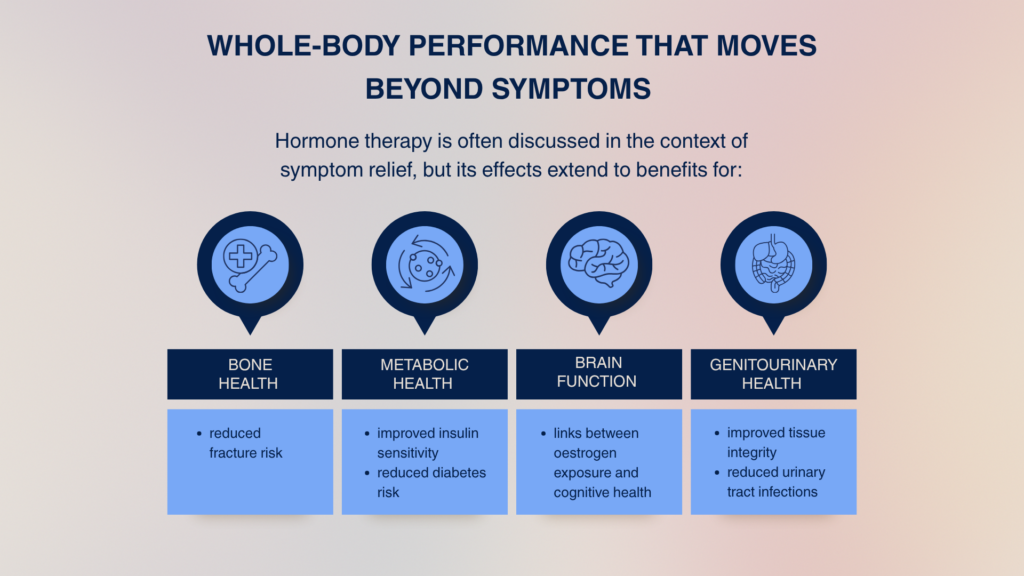
Whole-body performance that moves beyond symptoms
Hormone therapy is often discussed in the context of symptom relief, but its effects extend to benefits for:
- Bone health:
- reduced fracture risk.
- Metabolic health:
- improved insulin sensitivity
- reduced diabetes risk.
- Brain function:
- links between oestrogen exposure and cognitive health.
- Genitourinary health:
- improved tissue integrity
- reduced urinary tract infections.
Mental health, sleep, and resilience
Hormonal instability in perimenopause is strongly linked to mental health changes, with research suggesting an increased risk of depression during this phase that is driven by fluctuating hormones, rather than static deficiency. Dr Haver says stabilising oestrogen may, in some cases, be more effective than resorting to prescribing antidepressants.
Progesterone appears to support sleep by calming pathways in the brain, improving sleep quality when taken in the evening, and restoring recovery capacity.
Why so many women are missing out
Despite the growing evidence, access to hormone therapy remains limited. Dr Haver says only about 10 per cent of women are offered HRT, with many instead being prescribed antidepressants, highlighting the gap between emerging science and clinical practice.
When HRT is not appropriate
Hormone therapy is not suitable for everyone, and may not be recommended in cases of:
- active blood clots
- certain cancers
- severe liver disease
- unexplained abnormal bleeding.
However, even in these cases, decisions are nuanced and should be made individually with a healthcare provider.
A shift in how we think about menopause
Hormone therapy is not a universal solution, nor is menopause a condition that should simply be endured. The emerging view is not about prolonging youth, but about supporting function, maintaining performance, protecting longevity, and preserving choice.
As Dr Mary Claire Haver says, not every woman will take hormone therapy, but every woman deserves the conversation. For many women, that conversation may be the difference between navigating menopause as a period of decline, or as a phase of life still defined by strength, capability, and control for peak performance.