Creative practice can give first responders and military personnel a way to process experience, preserve shared memories and remain connected to the people and places that shape them. Through drawing, painting and printmaking, Keith Ross captures the humour, gratitude and ordinary moments found across a life of service, family and community.
Keith Ross has spent much of his life in service to other people. He is a first responder. He has served for more than a decade as an Army Reservist. He has been part of the Country Fire Authority since he was sixteen, because growing up in country Victoria, volunteering with the local brigade was simply what people did. Service has never been something he has spoken about in grand terms. Instead, it’s been part of the rhythm of everyday life, alongside family, work and community.
Running quietly alongside all of it has been another constant: drawing. “I’ve always drawn,” he says. “It’s something I can’t really help myself doing.”
Unlike many artists who discover creativity later in life, Keith traces his fascination back to primary school, when he came across an image by Australian painter Albert Tucker. Although he was too young to fully understand its themes, something about the work captured his imagination. From there he became increasingly fascinated by Australian artists who were trying to understand the country’s identity through paint, pencil and print.
“I became really interested in how artists depicted the Australian psyche,” he says. “The Angry Penguins, Boyd, Tucker, Percival. I was drawn to the way they looked at Australia and the people who lived here.”
He believes the ability to create is something most people begin with. “I think making art is an innate ability,” he says. “People just tend to stop.”
Life interrupted his own practice for a time. Careers were built, children were raised and responsibilities naturally took precedence. Yet creativity never disappeared entirely. It remained close by, waiting for the quieter moments when he could return to it.
“Art has always been something I’ve needed to do,” he says. “If I haven’t drawn for a week, I become a little restless.”
Today, creating something each day has become less a goal than a habit. Sometimes it is a finished drawing. Other times it’s a quick sketch on the train to work, a photograph captured on his phone or time spent carving a linocut block. The medium matters less than remaining connected to the process itself.
“It keeps me grounded,” he says. “Whatever’s happening in daily life becomes much easier to deal with if I’ve got something creative to immerse myself in.”
Feeding creative flows and memories
That sense of immersion is familiar to anyone who has experienced creative flow. Keith describes looking up from a drawing only to realise that hours have disappeared unnoticed. Time gives way to concentration, and concentration becomes a form of quiet reflection.
Unlike the pressures of work, creativity asks nothing of him beyond attention, which increasingly settles on subjects many people might overlook. For example, birds appear repeatedly throughout his work, particularly magpies. They are rarely symbolic in the conventional artistic sense. Instead, they are companions from childhood, reminders of growing up on a farm in country Victoria where birdsong formed part of the soundtrack of everyday life. Moving away from that landscape made him realise how deeply those ordinary sounds had shaped his sense of home.
“You don’t really notice them until they’re gone,” he says. “Then you realise something’s missing.” Now living in the Dandenong Ranges, he is surrounded by king parrots, black cockatoos and countless native birds, yet the familiar warble of a magpie still evokes something immediate.
“When I see one now, I’m genuinely happy.” It is a small observation, but one that reflects the broader philosophy running through his work. Keith is less interested in dramatic moments than the quiet details that give everyday life its texture.
“My work is really about taking stock and being thankful for ordinary things,” he says. “Without those ordinary moments, something feels missing.” That appreciation has only deepened with age.
Immersing oneself in the moment
Police work, emergency service volunteering and military service expose people to difficult moments in other people’s lives. They also remind them how fragile ordinary life can be. Rather than letting those experiences harden his outlook, Keith has found himself becoming increasingly attentive to simple pleasures that might once have gone unnoticed.
“The older you get, the more people you lose and the more difficult stories you hear,” he reflects. “I’ve had a very fortunate life, and I think that gratitude naturally finds its way into my work.”
His paintings often place people in landscapes that appear cold or isolated, yet they always contain some quiet source of warmth. A campfire, a bird perched nearby, companions sharing a joke or the familiar comfort of a remembered place gently shifts the emotional centre of the image.
“Even if something looks dark, there’s usually warmth there as well,” he says. “It’s about sitting with the environment and appreciating it for what it really is.” Humour also occupies an important place in his practice.
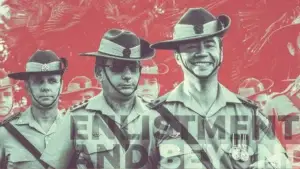
Many of Keith’s military drawings feature colleagues, shared experiences and the kinds of stories that become folklore within units over time. They are affectionate rather than heroic, built from countless small moments that only those who lived them together fully understand.
“The ideas mostly come from everyone else,” he laughs. “They’ve already done ninety per cent of the work. I’m just trying to capture it.”
Those works have become collaborative in an unexpected way. Conversations, shared memories and years of friendship all find their way onto the page, creating images that preserve not simply events but relationships.
His commissioned work follows a similar path. When asked to produce an artwork celebrating Melbourne’s Shrine of Remembrance and its military history, he found himself quietly weaving his own memories into the composition. School friends appeared among the figures. Childhood stories surfaced in unexpected corners. Places that had shaped different chapters of his life found space alongside the official narrative.
“The more I worked on it, the more it became a labour of love,” he says. “I’d find myself laughing while I was painting because I was remembering all these little stories.”
Telling a story through visual mediums
That instinct to collect stories rather than simply record places continues to shape his artistic process. Keith rarely begins with a rigid plan. An initial sketch gradually evolves as new ideas emerge, characters appear and unexpected connections reveal themselves.
“I’ll often start with one idea,” he says. “Then the drawing decides it wants to go somewhere else.” Earlier in life he would have resisted that uncertainty, striving to produce exactly what he had imagined. Experience has taught him something different. “The older I get, the less I worry about controlling the outcome. If I enjoy making it, that’s enough.”
He has also learned that mistakes often become the most interesting parts of a piece. “Sometimes the things you never intended to do end up being your favourite parts.”
That generosity towards the creative process mirrors the generosity he brings to life more broadly. Whether mentoring younger Reservists, volunteering with the CFA, working as a police officer or spending time with fellow artists, Keith speaks about people with warmth, curiosity and affection. He remains quietly optimistic about the communities he belongs to, finding encouragement in the young people who continue stepping forward to serve and in the artists who generously exchange ideas with one another.
“There is something special about being around other artists,” he says. “You absorb their energy, their ideas and the way they see the world. Every drawing teaches you something.”
Ultimately, in a world that often rewards constant movement towards the next achievement, Keith’s work offers a different invitation. It asks us to slow down long enough to notice the things that have been sustaining us all along, because the ordinary moments we so easily overlook are often the ones that become the foundations of a meaningful life.