Emergency service personnel face repeated exposure to trauma and operational stress, creating a need for recovery approaches that reflect the physical, psychological and social realities of frontline work. Fire and Rescue NSW’s Mindfulness Program is testing an integrated model that combines peer connection, mindfulness-based practices and organisational support within existing injury management and return-to-work pathways. Early findings point to improvements in psychological symptoms, wellbeing and work capacity, offering broader insights into how emergency service organisations can design mental health support around the culture and operational experience of the people they serve.
For decades, mental health support in emergency services has largely followed a predictable path. When symptoms surface, individuals are referred into clinical systems designed to diagnose, stabilise, and treat. These pathways are structured, often necessary, and grounded in evidence-based practice. But they are also, by design, external to the operational environment. Care is something you step out of the job to receive, rather than something built into the way the job understands and supports its people.
For firefighters, that separation has created a quiet tension. The nature of the work is cumulative, physical, and deeply social. Trauma is rarely a single incident. It builds over time, carried in the body as much as the mind, shaped by the rhythm of shifts, the culture of crews, and the expectation to remain composed under pressure. Traditional models, while clinically sound, have not always accounted for how firefighters process that experience, how they engage with support, or what it takes to restore confidence and capability in a way that feels relevant to the role.
This is the context in which Fire and Rescue NSW trialled the Mindfulness Program. Rather than rejecting existing systems, the case study was designed to test whether a more integrated, operationally aligned model could better support firefighter recovery, engagement, and return-to-work outcomes over time.
“We need a model that sits closer to the reality of the job,” says Dr Grace Lee. “This model acknowledges that recovery is not only about symptom reduction, but about rebuilding capacity, reconnecting with peers, and returning to work with a different level of awareness and control.”
The shift that is now being tested in practice
FRNSW’s case study approached firefighter mental health with a level of design intent that reflects the complexity of the problem it’s trying to address. Rather than isolating symptoms or relying on a single intervention pathway, the program brings together multiple disciplines, operational insight, and structured recovery support into a single, integrated model.
“At its core, the FRNSW program is a mindfulness-based, multimodal intervention designed specifically for urban firefighters experiencing psychological injury, particularly those within workers’ compensation pathways,” explains Dr Lee.
“It was conceived from within the ranks, shaped by operational experience, and built around a clear observation: the traditional pathways available to firefighters were not always aligning with how they process trauma, engage with support, or rebuild capacity over time.”
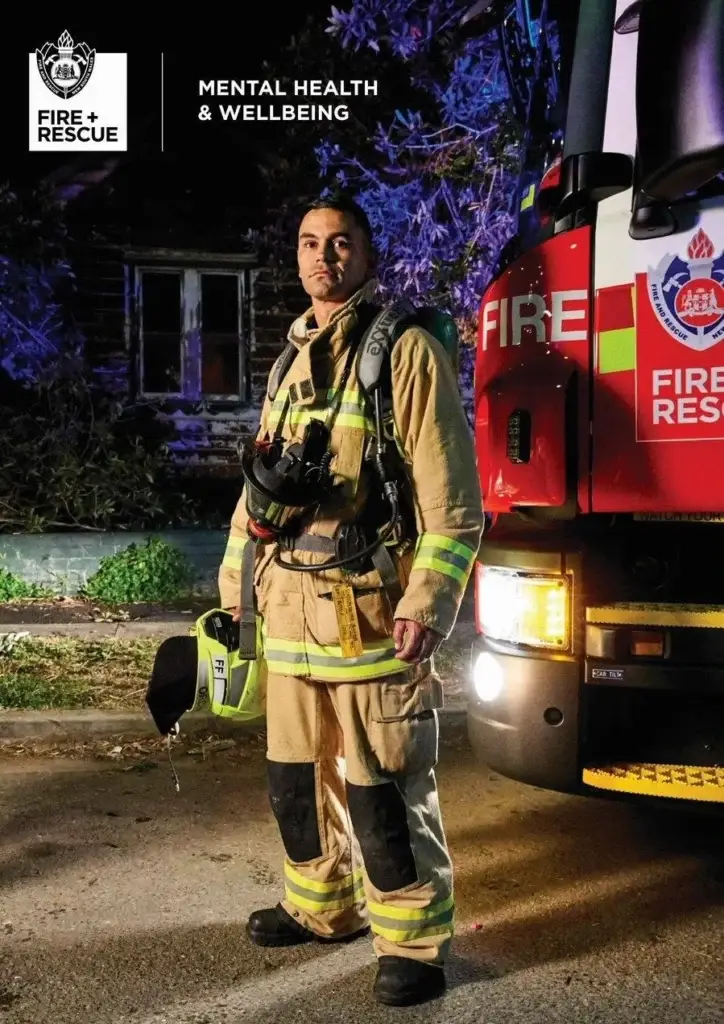
Designing for the realities of operational stress
The origins of the program sit in a very practical recognition. Firefighters operate in environments where exposure to trauma is cumulative, physiological responses are heightened, and emotional regulation can become compressed over time. The intervention was designed to address this as a system-wide challenge rather than a single-point issue.
This is reflected in the structure of the program. Delivered as an intensive retreat format, initially over four days and later extended to five, it brings together small cohorts of firefighters in an immersive setting. Each cohort typically consists of fewer than ten participants, allowing for depth of engagement and shared experience.
What distinguishes the program is its deliberate layering of modalities. Breathwork, Himalayan yin yoga, cold exposure, physical movement, bodywork, meditation, and creative practices such as art are all integrated into the experience. These are not treated as standalone activities, but as complementary pathways that collectively address physiological regulation, emotional processing, and cognitive awareness.
Participants consistently describe the impact as emerging from this combination, rather than from any single component. The design recognises that trauma in this context is not purely psychological. It is embodied, behavioural, and social, and the intervention reflects that breadth.
A program shaped by trust and cultural alignment
One of the defining characteristics of the FRNSW approach is how closely it aligns with firefighter culture. The program is delivered by facilitators who understand the operational environment, many of whom have direct experience in emergency services or related fields. This alignment reduces barriers to engagement and creates a shared language from the outset.
Participants attend alongside peers who have faced similar experiences. The cohort model reinforces a sense of belonging that is often disrupted when firefighters are removed from active duty. This shared context plays a central role in rebuilding confidence and engagement.
The program is also embedded within a broader system of support. Injury management teams, return-to-work advisors, and employer representatives are actively involved in the recovery process. This creates continuity between the retreat experience and the operational workplace, rather than positioning them as separate environments.
This combination of peer connection, organisational involvement, and culturally aligned facilitation creates conditions where participants are more willing to engage, remain present, and apply what they learn.
Measuring change across multiple dimensions
The FRNSW program has been evaluated using a mixed methods approach, combining quantitative measures with qualitative insights. Data is collected at baseline, immediately after the intervention, and at three- and six-month follow-ups.
Standardised tools like the Depression Anxiety Stress Scale (DASS-21), the PTSD Checklist (PCL-5), and the Personal Wellbeing Index are used to track changes in psychological health. Work capacity is also monitored, capturing movement between being unfit for duty, on suitable duties, and returning to pre-injury roles.
Across the pilot cohort, the data shows clear patterns. There are significant reductions in depression, anxiety, stress, and trauma symptoms immediately following the intervention, with improvements sustained at follow-up points. PTSD scores, in particular, shift from levels indicative of probable diagnosis into sub-clinical ranges, and remain there over time.
The data shows a clear trajectory. Symptoms of depression, anxiety, stress, and trauma reduce significantly following the intervention, with some increase over time, but remaining below baseline levels. Subjective wellbeing follows a different pattern, improving at the three-month mark and holding above starting levels despite a slight taper.
Return-to-work outcomes provide another perspective. Over time, more participants transition back to pre-injury duties, while the proportion classified as unfit declines. There is a steady shift toward higher levels of work capacity, supported by individual progressions across the cohort.
These patterns are not uniform. Some participants improve quickly, others stabilise, and a small number experience setbacks. The overall direction, however, points to improved function and sustained engagement over time.
What participants describe
The qualitative data adds another layer of understanding. Participants speak less about symptom reduction and more about capability.
“I now have many coping mechanisms to turn to. I have confidence that I can use the tools.”
“I have found that my reaction to stressful circumstances has been almost flat-line.”
“I am a lot more aware of my emotional and physical indicators of stress and anxiety.”
“An incredible shared experience with ‘my people’… I felt validated.”
“The summit was the main factor in me returning to work.”
These responses cluster around several themes. Personal agency emerges strongly, with participants describing a shift from passive treatment to active self-management. Emotional and physiological awareness increases, allowing earlier recognition of stress responses. Social connection is re-established, often after periods of isolation. Practical skills are acquired and applied, supporting day-to-day functioning.
The program does not position itself as a standalone solution. It operates as an adjunct within a broader recovery pathway, often acting as an entry point that enables further engagement with ongoing care.
Sustaining the impact
One of the more nuanced findings relates to what happens after the intervention. While improvements are sustained, there is a gradual re-emergence of symptoms over time. Participants who continue to engage with the practices introduced during the program tend to maintain stronger outcomes.
This has informed the evolution of the model. The program has been extended to five days to allow greater integration before participants return to daily life. Ongoing “waves of wellness” sessions and periodic refresher days provide opportunities to reinforce skills and reconnect with peers.
Over three years, the program has expanded to include more than 100 participants, with a notable number returning for additional retreats. The consistency between pilot and extended data suggests that the underlying design is holding across larger cohorts.
A model others can interpret
What emerges from the FRNSW program is not a fixed template, but a set of design principles grounded in operational reality.
It is a program developed from within the workforce it serves. It integrates multiple modalities to reflect the multi-system nature of trauma. It prioritises trust, cultural alignment, and peer connection. It connects intervention with organisational structures such as injury management and return-to-work planning. It measures outcomes across both clinical and functional domains.
There is also a clear understanding that context matters. The program itself acknowledges that it cannot simply be transplanted into another organisation without adaptation. Each agency operates within its own systems, cultures, and constraints. What can be shared is the approach to building something that fits those conditions.
The experience of FRNSW shows what becomes possible when mental health support is designed with the same level of intent, integration, and operational awareness as the work firefighters perform every day.