Menopause alters how the body responds to exercise, reducing the effectiveness of traditional high-volume cardio approaches and changing how strength, recovery, and metabolism are maintained. These shifts require a recalibration of training strategies, with greater emphasis on resistance work, intensity, and recovery to sustain performance, health, and long-term physical function.
For the first decades of women’s lives, the go-to fitness regime is to train hard and the results will follow, but menopause turns that formula on its head.
This new phase of life, which hits women typically in their 40s and 50s, can disrupt even the most disciplined woman’s exercise performance. Training hard loses its effectiveness, weight shifts regardless of diet, recovery slows, and sleep unravels, quite literally, with the onset of night sweats.
The instinct for many is to train even harder, eat less, and push through. However, according to a growing body of research, that may be the very thing that works against women during menopause.
Instead, experts including Dr Stacy Sims, Dr Rhonda Patrick, Dr Peter Attia, and Dr Mary Claire Haver say that menopause is not the end of high performance, and requires a fundamental shift to new strategies for training, diet, hormone therapy, recovery, sex, and sleep.
Why more cardio isn’t the answer
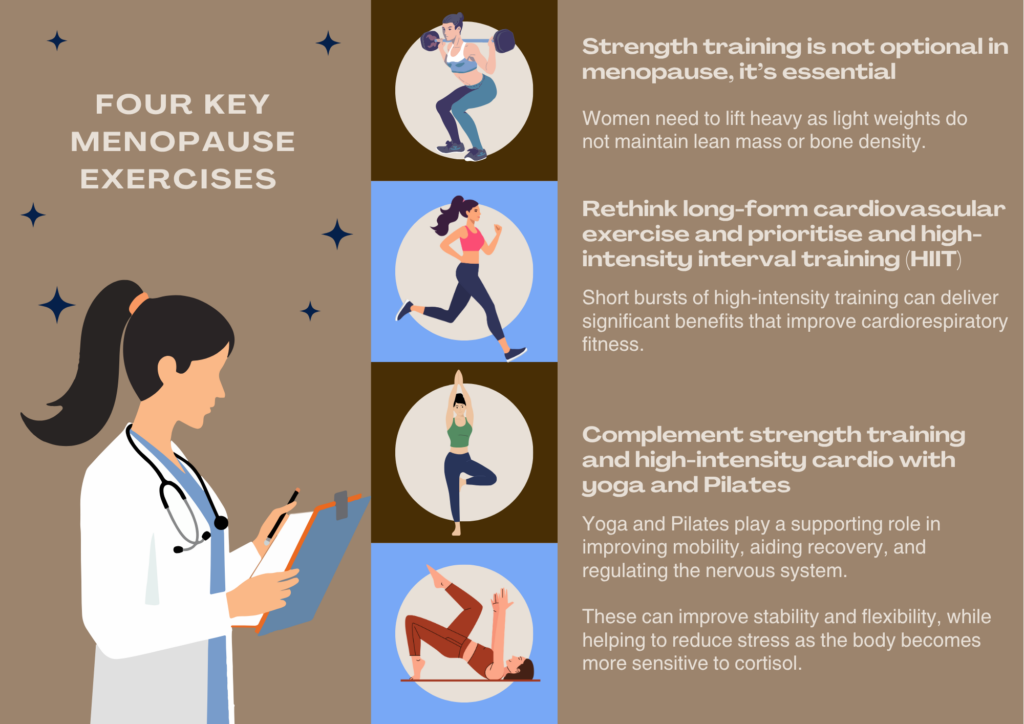
Menopause doesn’t end performance, but it does demand a different way of playing the game. Across the research, experts agree that women should rethink long-form cardiovascular exercise and instead prioritise weight training and high-intensity interval training (HIIT), sometimes referred to as ‘cardio snacks’. Weight training counteracts the effects of a slower metabolism, as well as muscle and bone density loss.
Dr Stacy Sims, an exercise physiologist and nutrition scientist specialising in female performance, says women need to lift heavy as light weights do not maintain lean mass or bone density and long-duration cardio can work against muscle development.
“This isn’t about pink dumbbells, this is about getting close to maximal load to stimulate muscle and bone,” Dr Sims said. “In menopause, women become more sensitive to stress, and long-duration endurance training can elevate cortisol in a way that works against muscle maintenance.”
Dr Peter Attia, a physician and longevity specialist, says muscle mass is one of the strongest predictors of longevity.
“If you look at the data, muscle mass and strength are among the strongest predictors of how well you’re going to age,” Dr Attia told the Huberman Lab podcast. “Strength is the foundation of health span, and it’s not just about looking good, it’s about preserving function and independence later in life.”
Dr Mary Claire Haver, an obstetrician-gynaecologist and menopause specialist, says exercising in menopause isn’t about shrinking your body, it’s about building strength.
“Strength training is not optional in menopause, it’s essential,” Dr Haver said. “Muscle is your metabolic engine, and we start losing it rapidly in menopause if we don’t actively work to maintain it, [so] if all you’re doing is cardio, you’re missing the most important piece: preserving muscle.”
Dr Rhonda Patrick, a biomedical scientist specialising in nutrition, ageing, and metabolic health, describes how these ‘cardio snacks’ can deliver significant benefits that improve cardiorespiratory fitness.
“Even very short bouts of high-intensity exercise can significantly improve VO₂ max,” Dr Patrick told the Huberman Lab podcast. “High-intensity exercise and resistance training have powerful effects on metabolic health, particularly as we get older.”
Mobility and recovery: where yoga and Pilates play a supporting role
While strength and high-intensity training are the foundation of fitness in menopause, yoga and Pilates play a supporting role in improving mobility, aiding recovery, and regulating the nervous system. These can improve stability and flexibility, while helping to reduce stress as the body becomes more sensitive to cortisol.
However, the experts are clear: weight training and short bursts of high-intensity cardio remain the foundation for optimal performance in menopause as yoga and Pilates on their own do not provide sufficient load to maintain muscle mass. These modalities are best placed as part of an overall training regime that supports recovery and reduces injury risk, allowing women to continue training at a high level.