Creative practice can help veterans explore identity, emotion and purpose as they move beyond military service. Former Navy officer Kat Dempsey’s journey through acting, writing, dance and directing shows how vulnerability can support both artistic expression and personal transition, while veteran arts communities give current and former ADF members permission to create without the pressure of perfection.
For many people leaving the military, transition is described in practical terms. It’s about finding a new career, establishing a new routine, or rediscovering purpose beyond service. Yet there is another transition that unfolds in a more personal way: the gradual process of learning how to become vulnerable again.
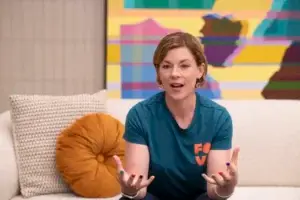
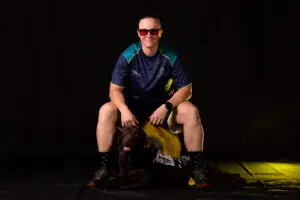
Former Royal Australian Navy officer, artist and Director of The Australian National Veterans Arts Museum (ANVAM), Kat Dempsey has spent the past decade navigating that journey. An actor, writer, director and dancer, she speaks about creativity with the clarity of someone who understands both the discipline of military service and the freedom required to make meaningful art. For her, the greatest challenge after leaving Defence was not learning a new profession. It was learning how to remove the emotional armour that service had taught her to wear.
The lesson arrived unexpectedly during a screen acting intensive shortly after leaving full-time service. After filming a scene, an acting coach gave her feedback that would reshape the way she understood both acting and herself.
“The camera could see my strength,” Kat recalls. “She said I was wearing armour and that the camera saw all of it. Once she learned I had just left the military, she told me that was exactly what the camera was seeing. She said if I wanted to become the actor I was capable of being, I would have to peel all that armour off.”
Finding the freedom in vulnerability
It was an observation that reached far beyond performance. Military service asks people to become dependable under pressure. Emotions are managed, decisions are made quickly, problems are solved, and confidence becomes part of the uniform. Those qualities build capable leaders, but they also become deeply embedded ways of moving through the world.
Acting demanded something entirely different. Over the next ten years, Kat found herself repeatedly moving between two identities. She would remove the armour to immerse herself in creative work, then put it back on whenever she returned to the navy uniform. The process became less about changing careers than learning to move between two fundamentally different ways of existing.
“It became a ten-year journey,” she says. “Every time I stepped back into uniform, the armour came back on. Every time I returned to acting, I had to learn how to take it off again.” Rather than experiencing vulnerability as something frightening, she discovered it as a form of freedom.
“Removing the armour let me discover emotional depth I didn’t know I had. It let me become a better artist and a more truthful performer.” That discovery sits at the heart of every artistic discipline Kat has pursued.
Moving through the arts
As a writer, she found herself drawn to fiction because it offered complete creative freedom. Unlike acting, where the story already exists and performance is shaped collaboratively, writing lets her build entire worlds from imagination. Characters emerged with histories, motivations and voices of their own. Her current novel follows a Navy veteran who becomes a homicide detective, allowing her to explore a life that might have unfolded differently while examining the questions that have always fascinated her.
“There is enormous privilege in creating a world that someone else gets to step into,” she says. “You hope they find something about themselves while they’re there.”
That act of sharing inevitably requires vulnerability. Every story carries something of its creator inside it. Kat believes this willingness to reveal something authentic is what gives art its enduring power.
“Artists hold a mirror up to all the facets of life. We explore and expose the parts of ourselves that people don’t always show each other. That only happens when we’re prepared to be vulnerable.”
The same lesson applies to dance. During military service, she learned to think of the body primarily as something that carried out tasks efficiently. At drama school, that understanding was turned inside out. “My body stopped being simply the vessel carrying my brain around. It became the instrument.”
The shift required abandoning perfection. Military culture often rewards precision, planning and certainty. Creative work flourishes when control loosens enough for instinct to emerge. “The biggest obstacle in my artistic practice is usually my own brain,” Kat says. “The moment I start trying to be perfect, I lose creative flow. The best work comes when I let go of perfection and simply enjoy making the art.”
That rhythm between discipline and creativity no longer feels like a contradiction. The leadership skills she developed as a Maritime Warfare Officer now shape her directing. Coordinating specialists, building teams, managing budgets and working toward a shared vision all transfer naturally into theatre production. Service gave her capabilities she now applies in an entirely different environment. “The vision and mission changes,” she says. “The leadership doesn’t.”
Creating space for creativity
Today, Kat brings those experiences together through her work with the Veteran Arts Community, where she regularly meets current and former serving ADF members, and families of veterans, beginning creative journeys of their own. The hesitation she sees does not come from a lack of talent. Instead, it begins with permission.
“I see people struggling to give themselves permission to call themselves an artist,” she says. “Sometimes they’ve also struggled to call themselves a veteran. They’re carrying both identities very carefully.”
For many veterans, the first step into creative work is less about learning a new skill than allowing themselves to explore one that may have been waiting for years. Kat recalls a former senior officer attending a creative program after decades in uniform. The breakthrough had little to do with technique. “It came down to permission,” she says. “Permission to create. Permission to be himself.”
That insight shapes the philosophy behind the Veteran Arts Community she now leads through ANVAM. Workshops, performances and festivals become places where curiosity is welcomed without expectation. People arrive with different experiences, abilities and ideas about what creativity might mean, and they are all invited simply to be and to begin.
“I love helping people enjoy what they create without worrying whether it’s perfect or whether it’s enough.” She recognises the mindset because she has lived it herself.
Military service attracts people who solve problems, carry responsibility and hold themselves to exceptionally high standards. Creative practice asks for something equally demanding. It asks people to be seen.
“We’re all wearing armour,” she says. “Mine became apparent to me because the camera could see it, but we’re all wearing it. To really get to the heart of the arts, you have to take it off. And it is a life-long journey of transformation. It will never be perfect and that is what makes it relatable to others.”
For veterans navigating life after service, that may be one of transition’s quietest achievements. Not replacing one identity with another or leaving service behind. Simply discovering that strength and vulnerability can exist together, and that somewhere beyond the armour is the version of ourselves that has been waiting patiently to create.