
Hormonal changes during menopause disrupt sleep architecture and increase nervous system reactivity, reducing the body’s ability to recover, regulate stress, and maintain cognitive and physical performance. As sleep becomes lighter, more fragmented, and harder to sustain, its role shifts from a passive outcome to a critical driver of overall health, influencing everything from metabolic function to emotional stability and long-term resilience.
Sleep is one of the most critical levers women have in menopause to maintain strength, resilience, and cognitive function, yet it is often the first system to break down as hormonal shifts take hold and the night sweats begin.
Ironically for many, sleep disruption is one of the earliest signs of menopause, with the occasional restless night leading to fragmented sleep, night sweats, and insomnia that leaves women exhausted and unable to recover, driven by the hormonal waves rolling through the body.
Dr Stacy Sims, an exercise physiologist and nutrition scientist specialising in female performance, says insomnia becomes significantly more common in women experiencing severe menopausal symptoms, particularly those with frequent hot flushes.
“This has to do with lots of the perturbations from temperatures, of night sweats, increased sympathetic load, [and] not being able to get into a parasympathetic state,” Dr Sims told the Huberman Lab.
As oestrogen declines, its regulatory role in the brain begins to weaken, affecting key neurotransmitters including serotonin and melatonin, which are critical for sleep regulation, while increasing activation of the sympathetic nervous system (the body’s “fight or flight” response). The result is a shift in sleep architecture, with women experiencing lighter, more fragmented sleep and reduced time in deep, restorative stages.
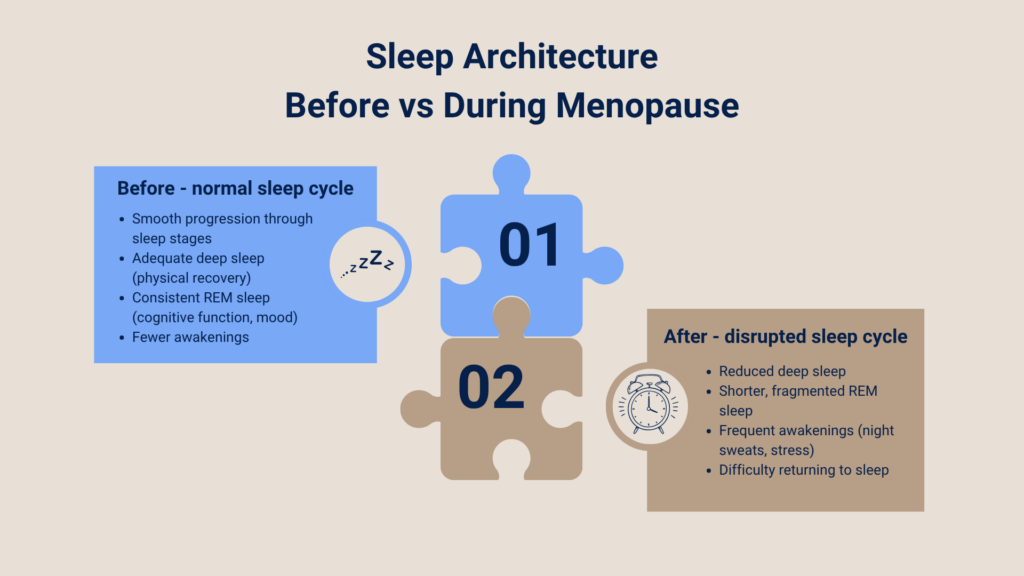
While symptoms such as night sweats can wake women, they are only part of the sleepless story, with Dr Mary Claire Haver saying many women continue to struggle even when night sweats are controlled.
“So, we see sleep disruptions from not only the vasomotor symptoms, which will wake you up … but what we’re seeing is people, even with HRT, still having middle-of-the-night awakenings or racing thoughts,” Dr Haver said.
This reflects a deeper neurological shift because as hormones fluctuate, the brain becomes more reactive, making it harder to transition into, and remain in a parasympathetic, rest-and-recover state.
One of the most important developments in menopause care is the growing understanding of progesterone’s role in sleep.
Dr Haver says progesterone appears to have a calming effect on the brain, likely through its interaction with GABA, a neurotransmitter that promotes relaxation. For this reason, many clinicians now recommend taking progesterone at night, with patients reporting improvements in both sleep onset and sleep quality.
This reinforces a broader shift in how hormone therapy is understood, that is not simply as symptom relief, but as a way to stabilise brain function and restore recovery capacity.
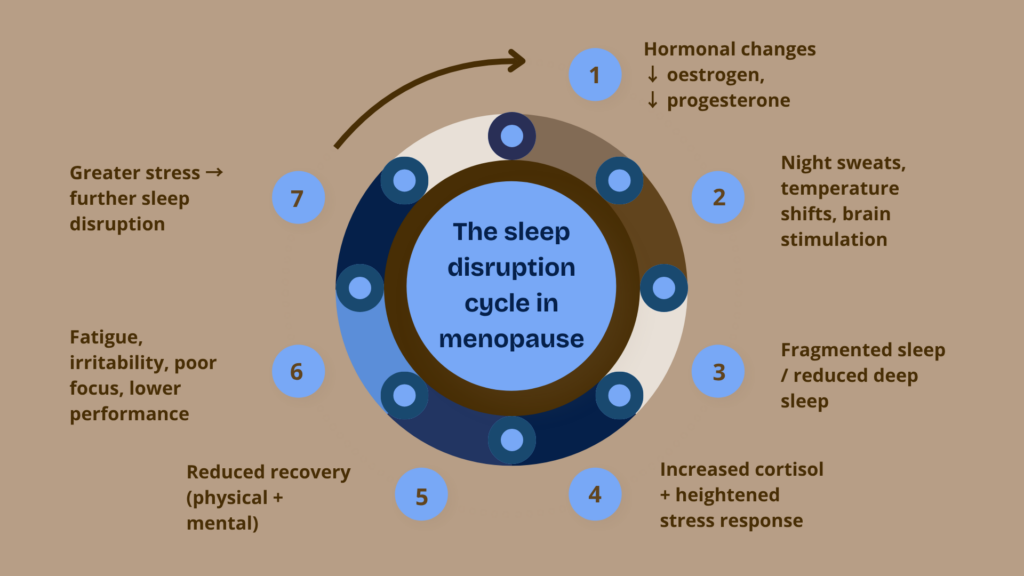
Sleep disruption in menopause does not exist in isolation, instead creating a cascade that affects nearly every system in the body. As sleep quality declines, cortisol levels rise, the nervous system becomes more reactive, and recovery capacity decreases, which creates a feedback loop where poor sleep increases stress, and elevated stress further disrupts sleep.
Dr Haver describes this as a “horrible depression” cycle many women find themselves trapped in.
The consequences of sleep disruption extend beyond fatigue and is linked to impaired cognitive function, increased anxiety, reduced training adaptation, and greater fat storage, making it one of the most important drivers of performance decline during menopause.
How much sleep?
While sleep disruption is common in menopause, the underlying requirement for sleep does not change, with most adults requiring between seven-to-nine hours per night. However, sleep duration alone is not enough, and the quality and structure of that sleep architecture are what determine how effectively the body recovers.
Sleep occurs in cycles, moving through light sleep, deep sleep, and rapid eye movement (REM) sleep, with each stage playing a distinct role. Deep sleep supports physical repair, immune function, and metabolic health, while REM sleep is critical for cognitive processing, emotional regulation and memory consolidation.
Sleep scientist Matthew Walker says both stages are essential for performance: “Sleep is the single most effective thing we can do to reset our brain and body health each day,” he says.
During menopause, this architecture is disrupted with less time spent in deep sleep, while waking more frequently and struggling to return to sleep reduces the restorative value.
What improves sleep in menopause?
Despite the hormonal disruptions, sleep hygiene remains a foundation of sleep quality.
Consistent sleep and wake times help stabilise the body’s circadian rhythm, while exposure to natural light early in the day and late in the afternoon, reinforces the brain’s sleep–wake cycle. In contrast, artificial light, particularly from phones and screens at night, can suppress melatonin production and delay sleep onset.
Temperature regulation also becomes more important in menopause and a cool, dark sleep environment can help offset the effects of night sweats and support the body’s natural drop in core temperature required for sleep.
Caffeine and alcohol tolerance also often change during menopause. While caffeine can elevate cortisol and disrupt sleep, alcohol may initially induce drowsiness, though fragment sleep later in the sleep cycle, reducing both deep and REM sleep.
Adequate nutrition also plays a role by stabilising blood sugar and supporting sleep, while micronutrients such as magnesium may assist with relaxation and sleep quality.
Menopause also decreases the body’s tolerance for sleep disruption and, where women may have previously been able to absorb poor sleep, irregular routines, or late nights, the hormonal chaos reduces that buffer.

Why sleep underpins everything
No recovery strategy can compensate for poor sleep as it is essential for brain function, metabolic health, and physical recovery.
“Sleep is the foundation of mental health, physical health and performance,” Dr Andrew Huberman says repeatedly on the Huberman Lab podcast.
While tools such as sauna, cold exposure, LED therapy, and compression boots may support aspects of recovery, they are secondary to the body’s primary recovery mechanism, which is sleep itself.
In menopause, sleep is no longer something that simply happens at the end of the day; it becomes a deliberate performance strategy. It’s when the brain recalibrates, the body repairs, and where the systems that govern strength, metabolism, mood, and resilience are restored.
The healthier women are when they enter menopause, the stronger their trajectory is likely to be, but when sleep is disrupted, it impacts every system that underpins performance.