Major projects create substantial opportunities for Australian businesses, but procurement teams assess more than technical capability and price. Suppliers must also demonstrate reliability, sound governance, responsible practices and the capacity to deliver under pressure. Early market engagement, complete supplier profiles and strong tender skills can help veteran-owned and specialist businesses compete for Brisbane 2032 contracts and broader procurement opportunities.
When people talk about the Brisbane 2032 Olympic and Paralympic Games, the conversation usually begins with the scale of the opportunity. Tens of billions of dollars will be invested in infrastructure, venues, services and experiences over the coming years, creating one of the largest procurement programs Australia has ever undertaken. For many business owners, the immediate question is how to win a contract.
Robert McRuvie, Director of Procurement for Brisbane 2032, believes there is a more useful question to ask first.
Before organisations buy products or services, they buy confidence. They need confidence that a supplier will deliver under pressure, manage risk responsibly and perform exactly as promised when the world’s attention is watching.
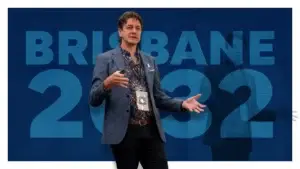
Speaking at VetCon26, McRuvie outlined what businesses need to understand about preparing for and participating in the procurement program behind Brisbane 2032. The Games will place Queensland before an audience of five billion people, who will experience every venue, transport system, security checkpoint, volunteer interaction and element that makes the event function. Behind those experiences will be a supply chain built from thousands of businesses, all expected to deliver seamlessly under extraordinary scrutiny.

Why capability must be backed by confidence
For procurement teams, that reality changes the way suppliers are evaluated. Capability remains essential, but buyers also need evidence that an organisation has the experience, financial stability, governance and operational maturity to deliver consistently when failure carries global consequences.
McRuvie illustrates the point through the men’s 100-metre Olympic final. Billions of viewers could be watching when a broadcast fails because a supplier overlooked a basic technical requirement. The issue might involve a single cable or a missed process, but its impact would extend around the world. Procurement decisions are therefore driven by a fundamental question about whether a business can be trusted to deliver when every detail matters.
That philosophy extends well beyond the Olympics. Whether the client is Defence, government, infrastructure, mining or a Tier 1 contractor, major projects are designed to minimise delivery risk. The successful supplier is often the organisation that provides the greatest confidence that its commitments will be met.
Procurement begins before the tender appears
Confidence begins long before a contract is released. Procurement starts well before a tender appears online, as buyers identify potential suppliers, understand the market and begin assessing available capabilities. Businesses that wait for the formal process can find themselves competing against organisations that have invested years in becoming visible and preparing for future opportunities.
Brisbane 2032 has deliberately opened supplier engagement earlier than any previous Olympic Games because Australia operates within a comparatively small business environment. The organisation wants businesses preparing years in advance by registering their capabilities, understanding future opportunities and positioning themselves to respond when packages are released.
For veteran-owned businesses, that preparation begins with a practical step. McRuvie encourages suppliers to register on the ICN Gateway platform and complete their profiles thoroughly. Procurement teams use this information during evaluation and shortlisting, meaning an incomplete profile can significantly reduce a business’s visibility before a conversation has begun.
“The first thing you should do is register,” he says. “The second thing is to make sure your profile is complete because we actually look at that when we’re evaluating and shortlisting suppliers.”
Every interaction with a buyer contributes to the confidence they develop in a supplier. A complete profile, current certifications, clearly articulated capability statements and evidence of previous delivery all reduce uncertainty before formal assessment begins.
Partial scopes create opportunities for specialist suppliers
Many small businesses also assume that participation depends on their ability to deliver an entire contract. Large-scale procurement creates multiple pathways for suppliers with specialised capabilities, including opportunities to contribute one part of a broader package.
Brisbane 2032 actively encourages businesses to register for partial scopes where they can contribute as part of a larger supply chain. Those registrations are shared with prime contractors, creating opportunities for collaboration and allowing smaller suppliers to become involved without expanding into areas beyond their established expertise.
“If you can only do part of the package, register for the partial scope,” McRuvie explains. “We’ll include those businesses in the tender information so prime contractors can find them, and where it makes sense we may even split packages to create opportunities for multiple businesses.”
For veteran-owned businesses, this approach creates an important strategic opportunity. They can establish credibility by delivering specialised components exceptionally well before expanding into larger contracts over time. This allows growth to be supported by demonstrated performance and strong relationships across the supply chain.
Responsible business practices influence buying decisions
Procurement has also evolved beyond an assessment of price and technical capability. Ethical supply chains, sustainability, workforce practices and social procurement commitments increasingly influence buying decisions because clients want suppliers to reflect the standards expected throughout the project.
Brisbane 2032 is looking for businesses that understand responsible employment practices, manage their own supply chains effectively and demonstrate the organisational maturity required to participate in a project of this scale.
Queensland’s recognition of veteran-owned businesses within its procurement policy also creates meaningful opportunities, provided businesses identify themselves appropriately within procurement systems and participate actively in the market. Visibility remains essential because buyers can only engage suppliers they can find and assess.
Tendering is a commercial skill
Businesses also need to understand that tendering is a learned commercial skill. McRuvie has found that many people who have submitted tenders have never completed formal tender training, leaving otherwise capable organisations poorly equipped to present their experience and evidence in a form that evaluators can use.
“That’s why most of you suck at it,” he says with characteristic humour. “Tendering is something you have to learn. It’s not like breathing.”
Many submissions fail because they overlook the questions being asked, provide insufficient evidence or concentrate on information the evaluator never requested. These mistakes can prevent a strong underlying business from progressing because the evaluation panel must assess the submission against defined criteria.
Businesses that invest time in learning how procurement works can place themselves ahead of competitors who continue approaching tenders as administrative paperwork. A tender is a form of commercial communication that must show the buyer how the supplier will meet the requirement, manage the associated risks and deliver the promised outcome.
Presentations can reveal capability that submissions miss
Brisbane 2032’s procurement approach also recognises that written submissions do not always reveal the full capability of a business. Many processes invite shortlisted suppliers to present directly to the evaluation panel, giving business owners an opportunity to explain how they will deliver the work.
This approach developed from the recognition that smaller businesses, social enterprises and First Nations organisations often understand their operations exceptionally well but can struggle to compete against organisations employing specialist bid writers. A direct presentation helps procurement teams assess the people behind the proposal, their practical knowledge and the relationships that will ultimately influence project delivery.
Strong supplier relationships support project delivery
Those relationships are a significant part of procurement success. Contracts establish obligations, while projects are delivered by people who need to resolve problems as they arise. McRuvie has seen open conversations with suppliers produce better outcomes than contractual enforcement alone when both parties are invested in delivering the project successfully.
Procurement, viewed this way, becomes a process of building partnerships capable of performing under pressure. Buyers need suppliers who will identify emerging problems early, communicate clearly and work constructively towards a solution. These behaviours build confidence throughout the contract and can become important evidence of capability when suppliers pursue future opportunities.
The Brisbane 2032 Games will require millions of individual items, thousands of contracts and approximately 150,000 people contributing across five weeks of competition. Very few businesses will supply everything, and many will contribute one specialised capability. Every supplier will still be assessed against the same underlying question of whether the organisation can be trusted to deliver exactly what it has promised.

Turning military experience into commercial evidence
For veteran-owned businesses, that question should feel familiar. Military service develops habits that procurement teams value highly, including disciplined planning, accountability, composure under pressure and a strong focus on delivering outcomes. These qualities are genuine commercial advantages when they are translated into language and evidence that procurement professionals can evaluate.
The businesses that succeed on major projects are often those that consistently demonstrate their reliability through evidence. Complete supplier profiles, relevant certifications, credible delivery histories, well-constructed tenders and strong relationships all help buyers understand how an organisation will perform when the stakes are highest.
Major projects buy confidence because confidence allows every other part of the project to succeed. Capability opens the opportunity, while preparation, evidence, transparency and reliable delivery give procurement teams the assurance they need to award the work.