Australia has significantly expanded its mental health workforce, service availability, and public investment over the past two decades, yet persistent rates of psychological distress, suicide, and unmet need continue to raise questions about how effectively support reaches those facing the most complex challenges. The debate has particular relevance for families, schools, frontline services, and community organisations working with young people, where delayed intervention, uneven access, and fragmented care can shape outcomes long before a person reaches crisis point.
I’ve spent eight years on the frontline of Australia’s youth mental health crisis. I’ve worked with over 3,500 families. I’ve seen children on seven different medications. I’ve watched parents break down after years of begging for help that never came.
And I’ve watched the mental health system grow into a billion-dollar industry while the kids I work with get sicker.
The data tells a story the industry doesn’t want you to hear. It’s a story of expansion without outcomes. Of investment without results. Of a system that grew for itself, not for the people it claimed to serve.
These four charts expose that story.
Chart 1: The workforce nearly doubled. The outcomes did not.
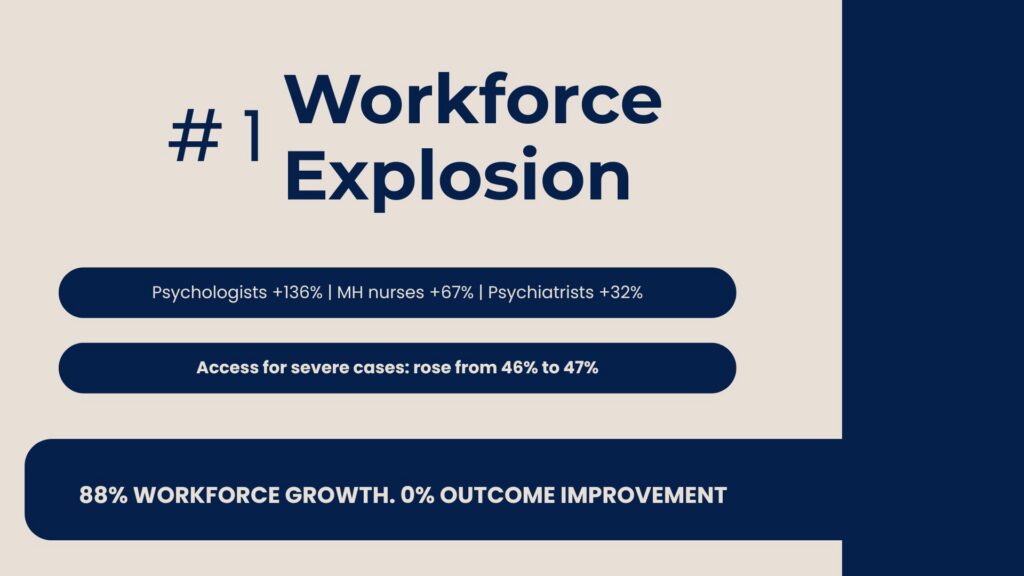
The numbers are staggering. Between 2007 and 2022, Australia’s mental health workforce exploded. Psychiatrists grew from 3,258 to 4,300. Mental health nurses expanded from 14,959 to 25,000. Psychologists surged from 14,000 to 33,000.
Combined growth: 88 per cent. The system nearly doubled in size. More professionals. More clinics. More Medicare-funded sessions. More everything.
According to AIHW data, psychologists recorded the largest workforce increase, adding 33 practitioners per 100,000 population. Mental health nurses added 17 per 100,000.
By 2022-23, psychologists were providing 49 per cent of all Medicare mental health services. Psychiatrists provided only 20 per cent. The system had fundamentally shifted toward psychology-dominated care.
Contacts for specialised community mental health care rose by over 1 million between 2013-14 and 2022-23, reaching 9.7 million.
The system grew massively. But suicide rates? They barely moved. Psychological distress? No improvement. Youth mental health? Worse than ever. This is the industry’s dirty secret. They built an empire. They just didn’t build it for the people who needed it most.
Chart 2: The system grew for the wrong people
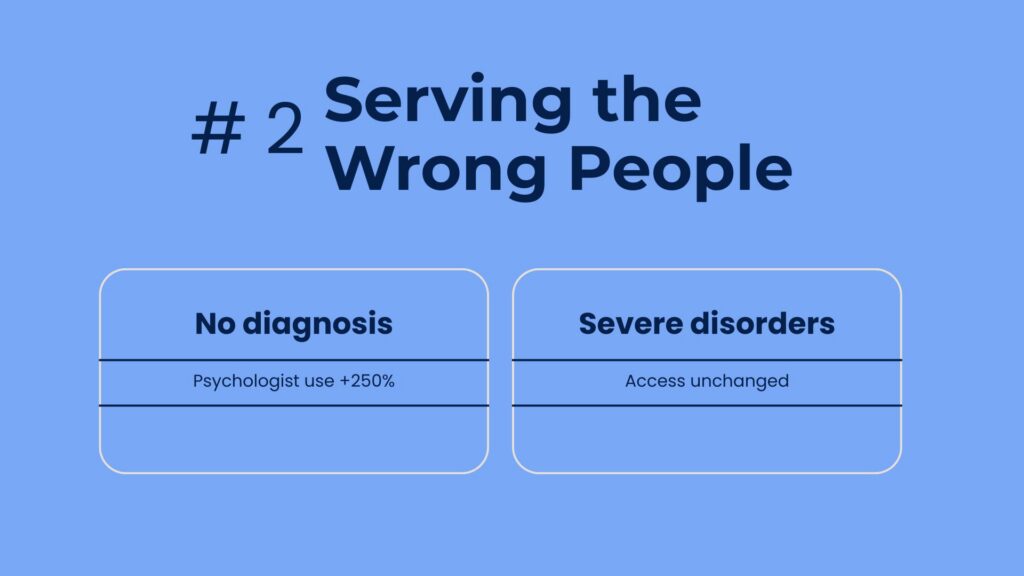
Here’s what really happened when the mental health system expanded. People with no diagnosis increased their psychologist use by 250 per cent. People with severe mental disorders? No meaningful change in access.
The Better Access program was supposed to help Australians get mental health support. But research shows it served some groups far better than others.
People from lower socioeconomic backgrounds got left behind. Those in regional and remote areas missed out. In 2022, less than half of low socioeconomic Australians could access treatment, including the additional 10 sessions. The national target for people with severe disorders to access care: 100 per cent.
The actual rate: 68.8 per cent. Access rates for people who actually needed help? They went from 46 per cent in 2013 to 47 per cent in 2022. Barely moved. New Better Access clients fell from 35 per cent to 25.8 per cent. The system was serving fewer new people who desperately needed intervention. Meanwhile, the worried well flooded in.
Studies found that Better Access had no detectable effect on the mental health of the Australian population. The large increase in service use after Better Access launched had no impact on psychological distress or suicide rates.
The system grew. But it grew for people who were already okay. The kids I work with? The ones expelled from school, self-harming, on multiple medications, whose parents are screaming for help? They’re still waiting.
Chart 3: We medicated our children
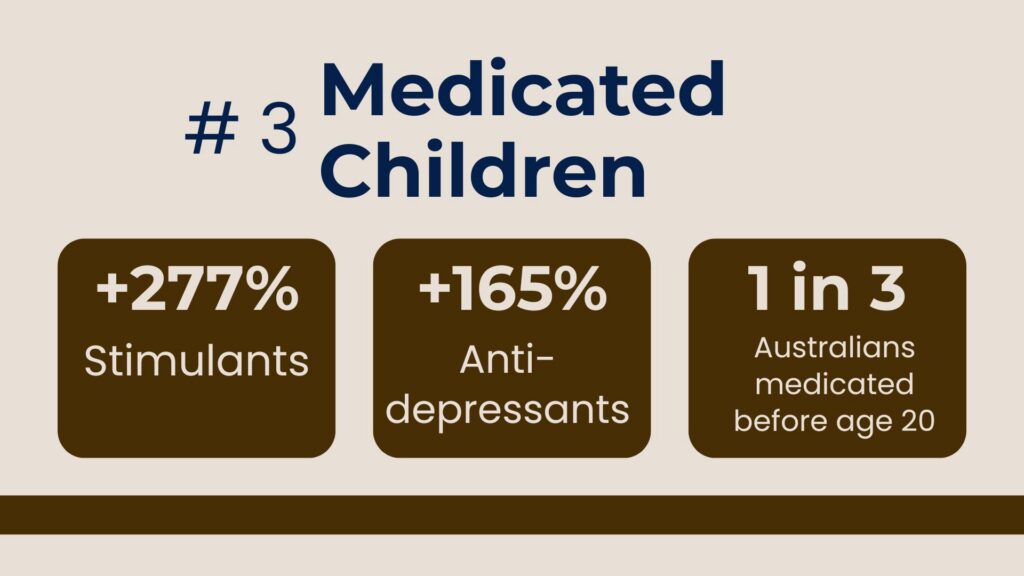
This chart should make you sick. Between 2013 and 2023, prescriptions of stimulant medications to Australian children increased by 277 per cent. Antidepressants prescribed to kids rose 165 per cent. All child psychiatric prescriptions more than doubled.
According to University of Adelaide research, prescriptions of drugs used to treat attention deficit disorders almost doubled between 2011 and 2018. Antipsychotic prescriptions increased 63 per cent. Antidepressant prescriptions rose 43 per cent. By 2018, 1 in 10 teenagers aged 15 to 18 were prescribed antidepressants.
One in three Australians received a mental health medication prescription before age 20. One in ten children were on two or more psychiatric medications simultaneously. Australia now prescribes stimulants at seven times the rate of Denmark. The prescribing surge accelerated during COVID-19, consistent with the pandemic’s impact on youth mental health. But the trend started long before 2020.
The overall prevalence of psychotropic dispensing to children rose from 33.8 per 1,000 boys and 25.2 per 1,000 girls in 2013 to 60.0 per 1,000 boys and 48.3 per 1,000 girls in 2021. We nearly doubled child medication rates in less than a decade. I see these kids on my programs.
Seven medications. Eight medications. Parents told this is the only way. Told their child needs chemical intervention before behavioural intervention. Before exercise. Before structure. Before mentorship. We medicated first and asked questions later. And the kids got sicker.Play
Chart 4: The system grew. These numbers grew with it.
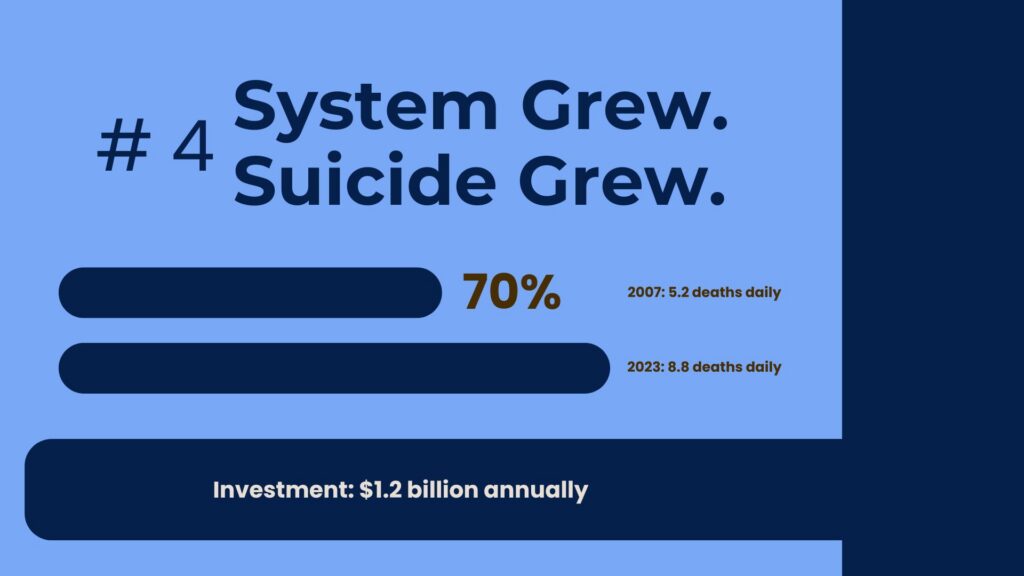
This is the chart that proves everything. In 2007, Australia’s suicide rate was 10.6 per 100,000 population. That’s 5.2 deaths per day. In 2023, the rate was 11.8 per 100,000. That’s 8.8 deaths per day.
According to ABS data, there were 3,214 suicide deaths in 2023. Suicide was the leading cause of premature mortality, with 107,537 years of life lost.
Suicide rates have fluctuated since the mid-1960s, dropping from a high of 18.4 per 100,000 in 1963. But since 2007, when the mental health system exploded in size, rates barely moved.
The rate hit a post-2006 high of 13.2 in both 2017 and 2019. Despite an 88 per cent increase in the mental health workforce, suicide rates remain stubbornly high.
The system grew. Suicide grew with it. But it gets worse. Sexual assault victims in domestic and family violence situations: 95.8 per 100,000 in 2007. By 2024: 147.4 per 100,000. That’s a 54 per cent increase. In 2024 alone, there were 40,087 recorded victims of sexual assault. The highest number ever recorded in Australian history.
By 2021, one in every ten Australians received at least one Better Access service. The cost to the Australian government: $1.2 billion.
Despite this massive investment, psychological distress and suicide rates were not reduced. A RANZCP survey of 1,269 Australian psychiatrists revealed that 93 per cent believe the workforce crisis negatively impacts patient care. Eighty percent said workforce shortages contribute to burnout. Even the professionals know the system is broken.
What this data actually means
These four charts tell one story. Australia built a mental health industry. It hired tens of thousands of professionals. It spent billions of dollars. It created programs and frameworks and national strategies. And it failed the people who needed it most.
The system expanded for the worried well. For people with mild anxiety who could afford gap fees. For those living in cities with access to clinics.
The kids I work with? The ones expelled from school seven times? The ones self-harming? The ones whose parents have been screaming for help for years? They’re still falling through the cracks. Better Access evaluations found that the mental health of 20 per cent to 40 per cent of patients actually deteriorated. This may partly explain why population distress and suicide rates weren’t reduced when Better Access launched in 2006.
The system counted sessions. It didn’t count outcomes. It measured access. It didn’t measure results. It grew its workforce. It didn’t grow its impact.
Why early intervention is the only answer
I’ve spent eight years building Australia’s leading youth development program. I’ve worked with over 3,500 families. I’ve seen what works.
Early intervention works. Catching kids after their first suspension works. Teaching mental resilience before medication works. Giving parents tools before their child spirals works. But the system waits until kids are broken. Until they’ve been suspended seven times. Until they’re on multiple medications. Until parents are desperate and isolated. Then it offers ten Medicare-funded psychology sessions and calls it support.
The Youth Regiment exists because the current system failed. We focus on early intervention through schools. We work with families before they’re lost in the mental health maze. We provide education on resilience, not just referrals to clinics.
We catch kids early. We give them structure, mentorship, physical training, and tools. We work with parents, not around them. And we get results the billion-dollar system can’t deliver.
The system needs to change
These charts should make you angry. They should make policymakers angry. They should make parents angry. They should make every Australian angry. We built a system that serves itself. That measures its success by workforce size, not by lives saved. That celebrates expansion while kids die.
The data is clear. The system grew. The outcomes did not. We need a complete overhaul of how we approach youth mental health in Australia. We need early intervention in schools. We need to stop medicating first and mentoring never. We need programs that work with families, not systems that isolate them. We need to stop counting sessions and start counting lives changed.
The current system had its chance. It got billions of dollars and an 88 per cent workforce increase. And it failed.
It’s time for something different. It’s time for early intervention. It’s time for programs that actually work. It’s time to stop building empires and start saving kids. The data doesn’t lie. The system does.